Limit Calculator
Limit Calculator with Steps
Enter a function, choose the variable, and find the estimated limit as the variable approaches a number, infinity, or negative infinity. This calculator uses numerical approximation and is designed for learning calculus concepts.

What Is a Limit?
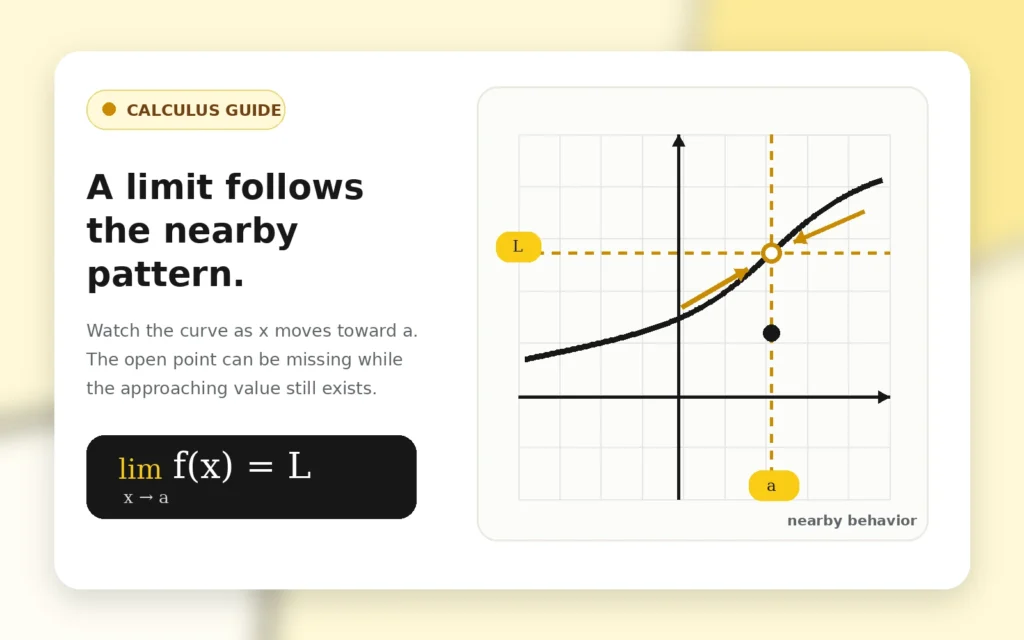
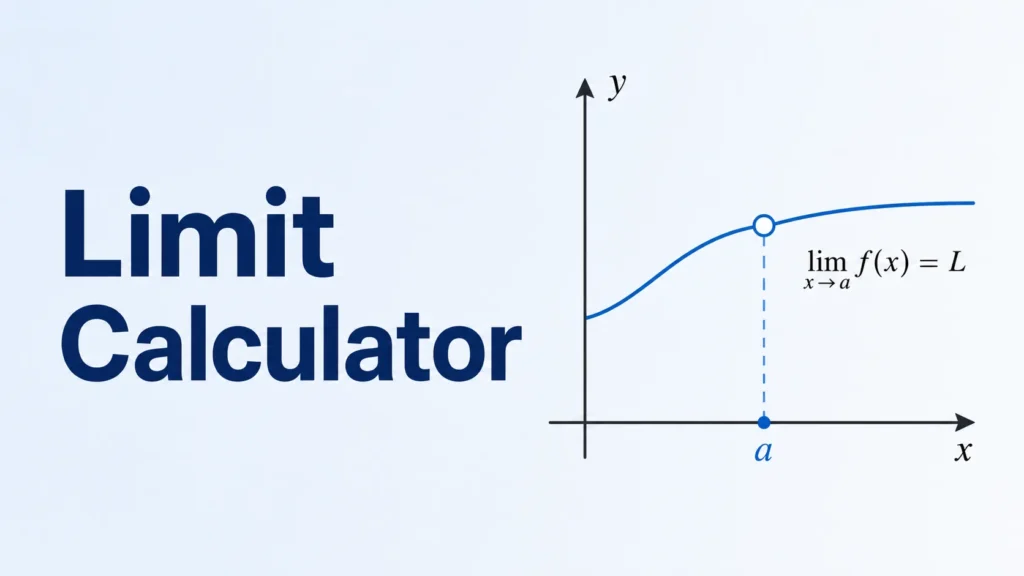
A limit describes the value a function approaches as the input gets closer and closer to a chosen number. In calculus, limits are used to understand function behavior near a point, even when the function is not actually defined at that exact point. A limit calculator helps students estimate this behavior by checking values close to the target input.
For example, a function may have a hole at x = 2, but the y-values on both sides may still approach the same number. That number is the limit. This idea is a foundation for derivatives, continuity, tangent lines, rates of change, and many AP Calculus and college calculus topics.
How to Use the Limit Calculator
- Enter the function, such as (x^2 - 4)/(x - 2), sin(x)/x, or sqrt(x+1)-1 divided by x.
- Enter the variable. Most homework problems use x, but another single variable can be used.
- Enter the value the variable approaches, such as 0, 1, 2, infinity, or -infinity.
- Choose two-sided, left-hand, or right-hand behavior.
- Click Calculate Limit to see the estimated answer, direct substitution result, nearby value table, and step-by-step explanation.
What Does “x Approaches a Number” Mean?
When a problem says x approaches 2, it means x gets closer and closer to 2 without necessarily being equal to 2. The calculator checks values such as 1.9, 1.99, 2.01, and 2.001 to see what the function appears to approach. This is why a limit is about nearby behavior rather than only direct substitution.
Left-Hand Limit vs Right-Hand Limit
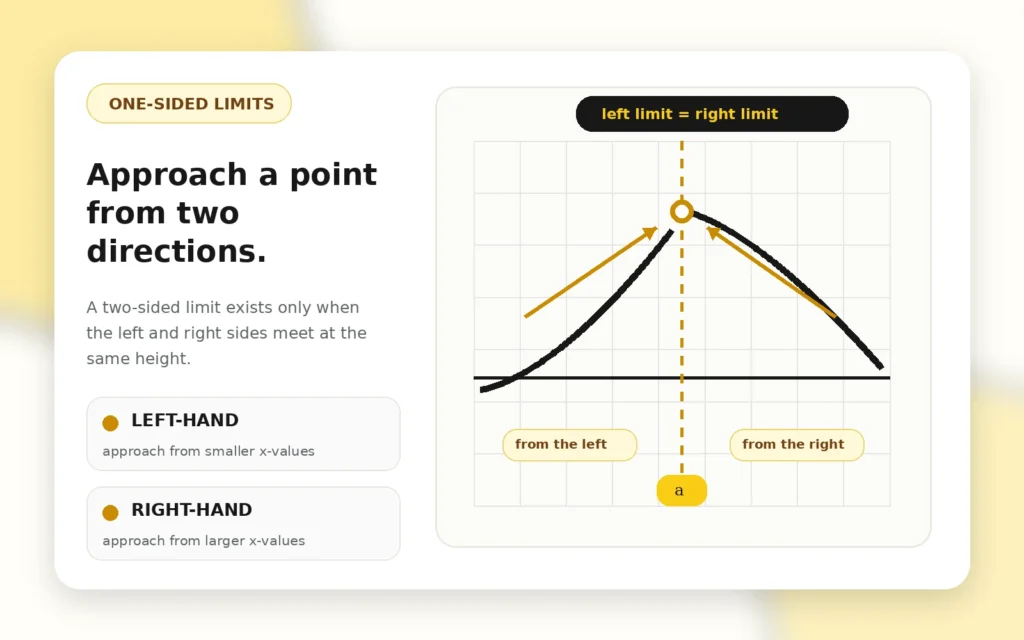
A left-hand limit studies the function as x approaches the number from below. A right-hand limit studies the function as x approaches the number from above. If the left-hand and right-hand limits are equal, the two-sided limit exists. If they are different, the two-sided limit does not exist.
Two-Sided Limits
A two-sided limit asks what the function approaches from both directions. For a two-sided limit to exist, the left-hand limit and right-hand limit must approach the same value. This calculator compares both sides for finite approach values and warns you when the values appear different.
Limits at Infinity
A limit at infinity describes what happens as x becomes very large. A limit approaching negative infinity describes what happens as x becomes very negative. These limits are often used to study horizontal asymptotes and end behavior. For rational functions, students commonly compare the highest powers of x in the numerator and denominator.
When Does a Limit Not Exist?
A limit may not exist if the function approaches different values from the left and right, grows without bound, has a vertical asymptote, or oscillates without settling near one value. For example, the expression |x|/x has a left-hand limit of -1 and a right-hand limit of 1 as x approaches 0, so the two-sided limit does not exist.
Common Indeterminate Forms
Indeterminate forms appear when direct substitution does not immediately reveal the limit. Common examples include 0/0, infinity/infinity, 0 times infinity, infinity minus infinity, 1 to the infinity power, 0 to the 0 power, and infinity to the 0 power. In many beginner calculus problems, 0/0 means you should try factoring, canceling, rationalizing, or using a known trig limit.
How Students Use Limits in Calculus
Students use limits to define derivatives, check continuity, understand tangent lines, analyze graphs, solve AP Calculus free-response questions, and study instantaneous rates of change. A limit solver can support calculus homework help by showing whether nearby function values approach a stable number.
Common Limit Rules
- Constant rule: the limit of a constant is the constant.
- Sum rule: the limit of a sum is the sum of the limits when both limits exist.
- Difference rule: the limit of a difference is the difference of the limits when both limits exist.
- Product rule: the limit of a product is the product of the limits when both limits exist.
- Quotient rule: the limit of a quotient is the quotient of the limits when the denominator limit is not zero.
- Power rule: powers can often be evaluated by applying the limit to the base first.
Limit Calculator Examples
Example 1: Factoring Limit
lim x→2 (x^2 - 4)/(x - 2)
Direct substitution gives 0/0, so factor the numerator:
x^2 - 4 = (x - 2)(x + 2)
After canceling x - 2, the expression becomes x + 2. Substitute x = 2 to get 4. Answer: 4.
Example 2: Common Trigonometric Limit
lim x→0 sin(x)/x
This is a standard trigonometric limit in calculus. As x approaches 0 in radians, sin(x)/x approaches 1. Answer: 1.
Example 3: Limit at Infinity
lim x→∞ (3x^2 + 2)/(x^2 - 5)
The highest power in the numerator and denominator is x squared. Compare the leading coefficients, 3 and 1. The limit is 3/1 = 3. Answer: 3.
Example 4: Limit Does Not Exist
lim x→0 |x|/x
From the left, |x|/x approaches -1. From the right, |x|/x approaches 1. Since the one-sided limits are different, the two-sided limit does not exist.
Common Mistakes When Finding Limits
- Assuming 0/0 means the answer is 0. It is usually an indeterminate form that needs more work.
- Forgetting to compare left-hand and right-hand limits.
- Using degrees instead of radians for trigonometric limits.
- Confusing the function value with the limit.
- Ignoring vertical asymptotes or values that grow without bound.
Why a Function Can Have a Limit Even If It Is Undefined
A function can have a limit at a point even when the function is undefined there because the limit only depends on what happens nearby. In the expression (x^2 - 4)/(x - 2), the original function is undefined at x = 2 because the denominator is zero. But after simplification, the nearby behavior follows x + 2, so the limit is 4.
Limit Calculator for AP Calculus and College Calculus
This calculus limit calculator is designed for AP Calculus students, college students, teachers, parents, and anyone who wants step by step limit calculator support. It can help with direct substitution limits, factoring limits, rational expression limits, one-sided limits, two-sided limits, limits at infinity, basic trigonometric limits, and questions like “does the limit exist?”
Because this tool uses numerical approximation in the browser, complex symbolic limits should still be checked with algebra, graphing, or your teacher’s method. The nearby value table is especially useful for seeing function behavior near a point and building intuition for limits in calculus.
Limit Calculator FAQs
What is a limit calculator?
A limit calculator is an online tool that helps estimate the value a function approaches as the variable gets close to a number, infinity, or negative infinity.
How do I calculate a limit?
To calculate a limit, enter the function, choose the variable, enter the value the variable approaches, and compare the function values near that point. Some limits can be found by direct substitution, while others require factoring, simplifying, or comparing one-sided behavior.
What is a left-hand limit?
A left-hand limit is the value a function approaches as the input gets close to a number from values smaller than that number.
What is a right-hand limit?
A right-hand limit is the value a function approaches as the input gets close to a number from values greater than that number.
What is a two-sided limit?
A two-sided limit exists when the left-hand limit and right-hand limit approach the same value.
What does it mean if a limit does not exist?
A limit does not exist when the function does not approach one single value. This can happen when the left-hand and right-hand limits are different, the function grows without bound, or the function oscillates too much near the point.
Can a limit exist if the function is undefined?
Yes. A limit can exist even if the function is not defined at the exact input value. Limits describe nearby behavior, not only the function value at the point.
What is an indeterminate form?
An indeterminate form is an expression such as 0 divided by 0 or infinity divided by infinity that does not immediately tell you the limit. These forms usually require simplification or further analysis.
How do you find limits at infinity?
For limits at infinity, study what happens to the function as the input becomes very large or very negative. For rational functions, comparing the highest powers of the numerator and denominator is often helpful.
Is this limit calculator useful for AP Calculus?
Yes. This AP Calculus limit calculator can help students practice direct substitution, one-sided limits, two-sided limits, limits at infinity, rational limits, trigonometric limits, and common cases where a limit does not exist.
Can this calculator show steps?
Yes. The calculator shows educational step-by-step explanations, direct substitution checks, nearby value tables, one-sided comparisons, and beginner-friendly notes. For complex expressions, the steps are numerical estimates rather than full symbolic algebra.
What is the difference between a function value and a limit?
A function value is the actual output at one input. A limit is the value the function approaches as the input gets close to that point. They can be the same, different, or the function value may not exist while the limit still exists.