Final Exam Calculator – What Grade Do I Need on My Final?
Use this free calculator to estimate the score you need on your final exam, check a possible final course grade, or see what you need to pass.

Required final exam score
--
Letter grade estimate
--
Letter grades may vary by school, professor, course syllabus, district, college, or university.
What can Final Exam Calculator – What Grade Do I Need on My Final? tell you?
Near the end of a course, one question matters most: “What do I need on the final?” This calculator gives you a practical estimate using the numbers already shown in your gradebook or syllabus.
You can also reverse the calculation. Enter an expected exam score to see a possible final course grade, or switch to the passing mode when your goal is simply to clear the course.
- Instant weighted-grade estimate
- Three useful calculation modes
- Clear result and what-if table
Read the complete Final Exam Calculator – What Grade Do I Need on My Final? guide
How to use Final Exam Calculator – What Grade Do I Need on My Final?
- Choose the mode that matches your question.
- Enter your current class grade.
- Enter the target grade, expected exam score, or passing grade.
- Enter the final exam weight exactly as shown in the syllabus.
- Select Calculate and review the result.
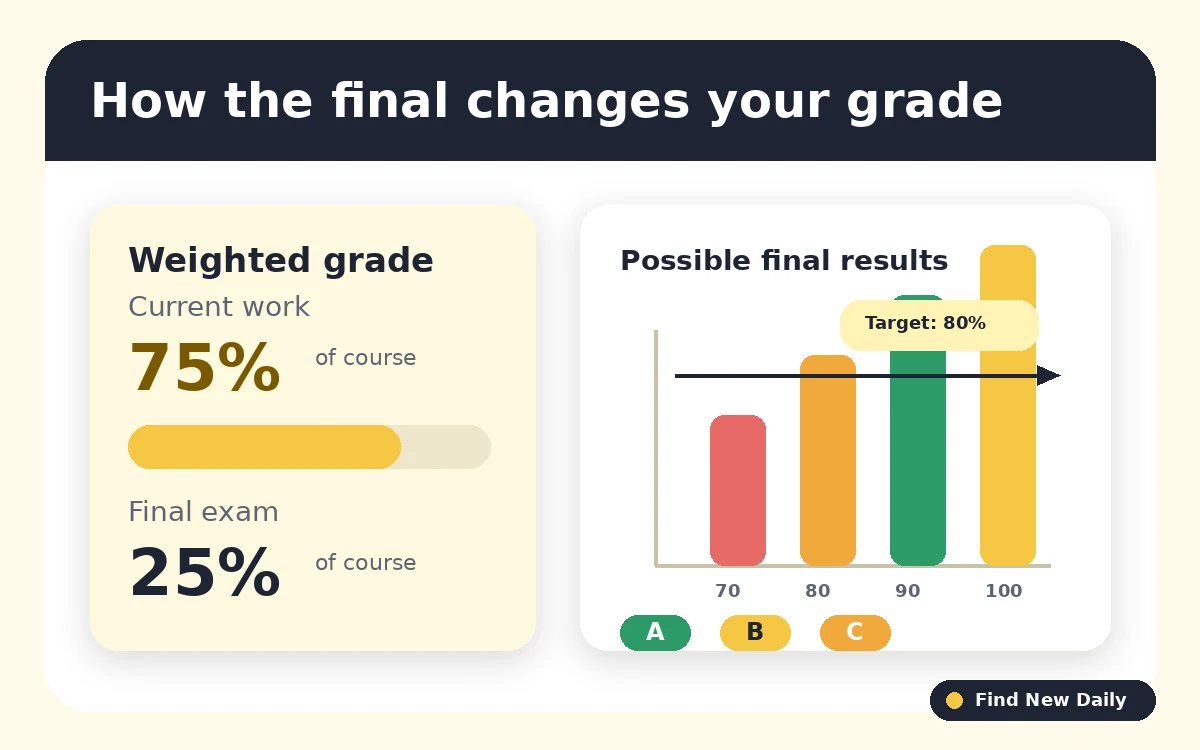
Use 25 when the exam is worth 25%. Do not enter 0.25. For the most reliable estimate, check that the current grade already includes all completed work.
Formula used by the calculator
To find the score needed on the final exam, the calculator uses this weighted-grade formula:
Required final score = (Target course grade − Current grade × (1 − Exam weight)) ÷ Exam weight
The exam weight is converted from a percentage to a decimal before the calculation. For example, 30% becomes 0.30.
A simple example
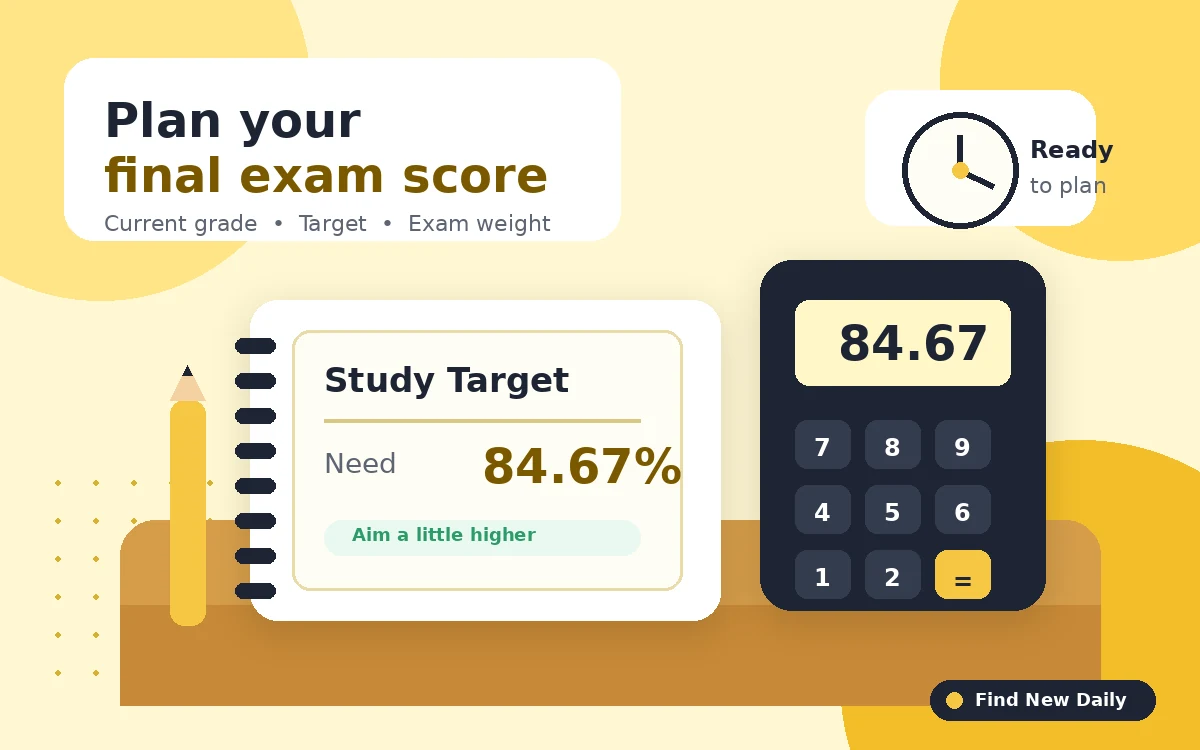
Suppose your current grade is 78%, your target is 80%, and the final exam is worth 30%. The required score is about 84.67%. A sensible study target would be slightly higher, such as 88% to 90%, so you have room for small mistakes or rounding.
Why the final exam weight matters
A final worth 10% usually changes the overall course grade less than a final worth 30% or 40%. That is why two students with the same current grade can need very different exam scores in different classes.
- 10%: smaller impact on the overall grade.
- 20% to 25%: a meaningful part of the course grade.
- 30% to 40%: a high-impact exam that can move the final result noticeably.
What if the result is above 100%?
A required score above 100% means the target is probably not possible through the final exam alone. Before giving up, check whether the class offers extra credit, bonus questions, a curve, dropped assignments, or corrections to missing grades. You can also try a slightly lower target to understand what is still realistic.
Practical ways to prepare
- Confirm the exam weight and grading scale in the syllabus.
- Review previous quizzes and tests to spot repeated question styles.
- Spend more time on topics that carry more marks.
- Set a study target a few points above the minimum score shown.
- Ask the teacher or professor about any missing work before the final.
Frequently asked questions about Final Exam Calculator – What Grade Do I Need on My Final?
How do I calculate what I need on my final exam?
Enter your current grade, target course grade, and final exam weight. The calculator then estimates the exam score needed.
What does final exam weight mean?
It is the percentage of your overall course grade that comes from the final. Enter 25 when the final is worth 25%.
Can I estimate my final course grade?
Yes. Choose “What will my final grade be?” and enter the exam score you expect to receive.
What if I need more than 100%?
The target may not be possible through the final alone unless extra credit, bonus points, or a grading curve is available.
Can this calculator check what I need to pass?
Yes. Choose the passing grade mode and enter the minimum overall grade required for the course.
How accurate is the result?
The math is accurate for the values entered. Official grades can still differ because of rounding, curves, extra credit, or special course rules.