First Apartment Move-In Cost Calculator – Estimate Your Moving Out Budget
Use the First Apartment Move-In Cost Calculator – Estimate Your Moving Out Budget to estimate apartment fees, utility setup, moving costs, furniture, and emergency savings before move-in.
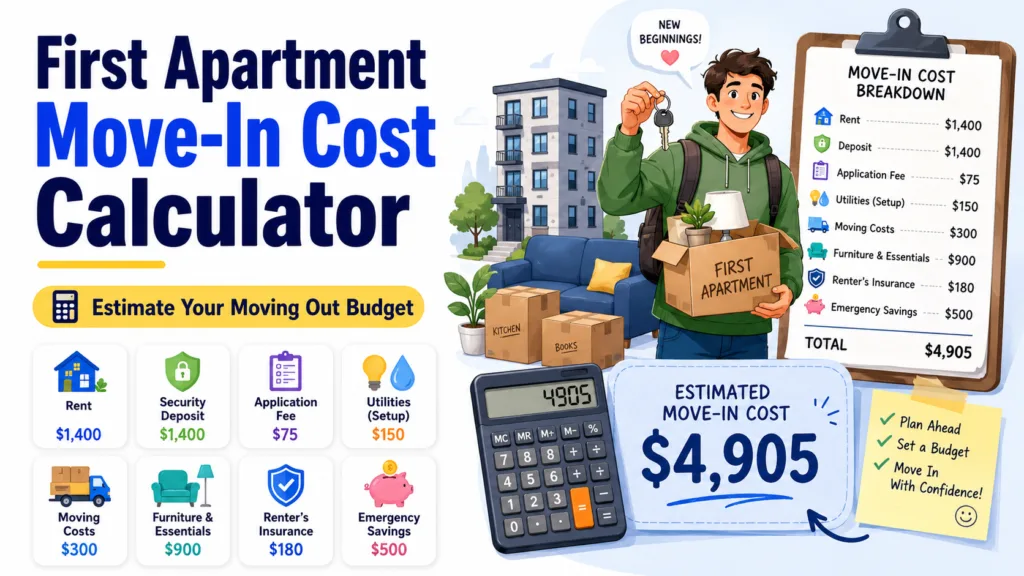
First apartment move-in checklist
Before you sign the lease, collect the real numbers from the landlord, utility companies, movers, and your shopping list. These are the costs people most often miss.
- First month’s rent
- Security deposit
- Application or admin fees
- Last month’s rent, if required
- Utility deposits
- Internet installation
- Renter’s insurance
- Truck, fuel, or movers
- Mattress and bedding
- Kitchen and bathroom basics
- Cleaning supplies
- Emergency cash after move-in
How to use the First Apartment Move-In Cost Calculator – Estimate Your Moving Out Budget
Start with the amounts that must be paid before you receive the keys. Then add utility setup, moving expenses, and only the household items you need during the first few weeks. The result panel updates while you type, so you can compare a solo move with a roommate plan without starting over.
The most useful number is not always the total shown at the top. Check your personal share and the amount left after the emergency buffer. That tells you whether the move is merely possible or whether it leaves room for groceries, transportation, and an unexpected bill.

What belongs in a realistic first apartment budget?
Rent and the security deposit are obvious, but move-in week usually includes several smaller charges. Application fees, parking permits, key fees, utility deposits, internet installation, boxes, fuel, a shower curtain, cookware, cleaning products, and laundry supplies can turn into a large second bill.
Move-in total = apartment fees + utility setup + moving costs + essential household items
Recommended savings = your personal move-in share + your chosen emergency buffer
Example: moving into a $1,500 apartment
Suppose the first month’s rent is $1,500, the deposit is $1,500, fees and utility setup are $425, moving costs are $300, and basic furniture costs $900. The immediate total is $4,625. If you also want one month of breathing room and expect $1,200 in non-rent expenses, your savings target becomes $7,325.
That does not mean every renter must save exactly that amount. A furnished room, a roommate, help from family, or second-hand furniture can reduce the total. The point of the calculator is to show which choices create the biggest difference for your own move.

Ways to reduce the amount you need upfront
- Ask for a written list of every charge due before move-in.
- Compare furnished and unfurnished apartments using the furniture section.
- Split only genuinely shared costs when using roommate mode.
- Price used furniture before buying a full matching set.
- Move boxes yourself and pay professionals only for heavy items.
- Keep some savings untouched instead of spending everything on move-in day.
Common move-in cost ranges
| Cost | What to confirm | Planning note |
|---|---|---|
| Security deposit | Refund rules and deductions | Do not assume it always equals one month of rent. |
| Utility setup | Deposits, activation fees, and first billing date | Ask whether any utilities are already included in rent. |
| Moving service | Hourly minimum, mileage, fuel, insurance, and tips | Weekday dates may be easier to book. |
| Furniture | What the apartment already includes | Start with sleep, food, hygiene, and safety essentials. |
Questions about first apartment costs
Try to cover all required move-in charges, basic setup costs, and at least a small emergency reserve. The right amount depends on your rent, lease, location, moving distance, and whether costs are shared.
Yes. Turn on roommate mode, enter the number of people, and choose which categories are shared. Costs you leave unshared remain fully assigned to you.
Include the items you must buy immediately, such as a mattress, basic cookware, bathroom supplies, and cleaning products. Optional decor can be added later.
No. The amount varies by landlord, lease terms, location, screening results, and local rules. Use the actual figure quoted for the apartment.
No. It is a planning estimate. Review the lease and confirm charges with the landlord, service providers, and any relevant local authority.