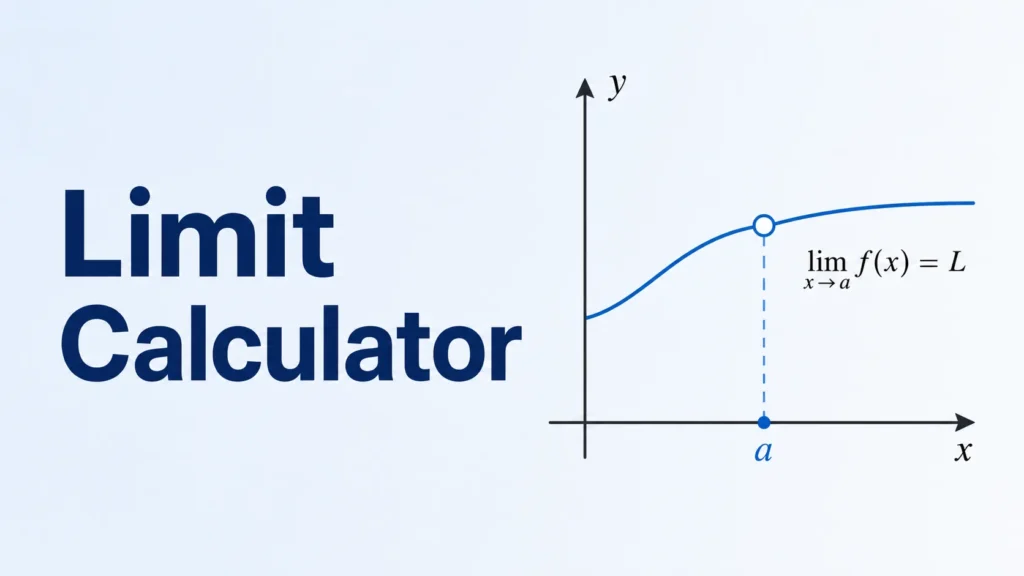
How the Limit Calculator Helps
A limit is not simply the value printed by a function at one point. It describes what the output is moving toward as the input gets very close to that point. That small distinction is why limit questions can still have an answer when direct substitution produces an undefined expression.
This page keeps the calculator at the top for visitors who only need a result. The explanation stays below it, so students can check the nearby values and then read more only when a concept needs clarification.
For a quick calculation
Enter the function, choose the direction, and press the yellow button. The result area compares nearby inputs and shows the estimate.
For learning the method
Open the complete guide below for worked examples, common mistakes, infinity limits, and one-sided comparisons.
Read the Graph Near the Target
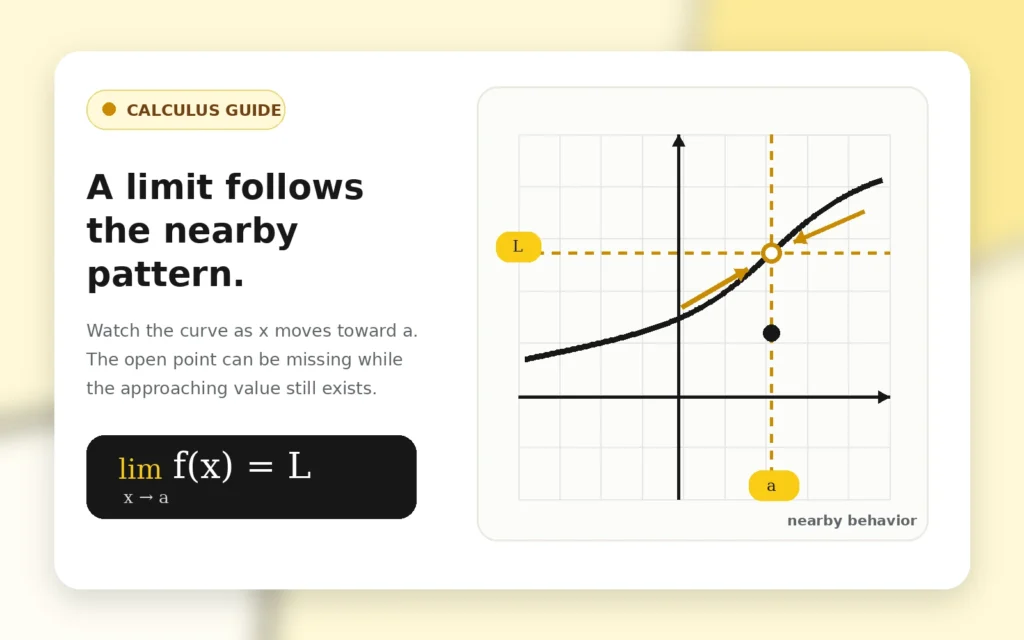
Imagine tracing the graph toward the target x-value from both directions. The y-value that the curve settles near is the limit. A hole in the graph does not automatically remove the limit; the nearby path matters more than the single missing point.
Read the complete Limit Calculator guide
How to Use the Limit Calculator
- Type the function using parentheses where needed.
- Keep x as the variable unless the question uses another variable.
- Enter the number the variable approaches, or type infinity or -infinity.
- Choose two-sided, left-hand, or right-hand.
- Review the final estimate and the table instead of relying on one nearby value.
Function Value and Limit Are Not Always the Same
Direct substitution asks for the output at the exact input. A limit asks what happens close to that input. For (x² − 4)/(x − 2), substitution at x = 2 creates 0/0. After factoring, the nearby expression behaves like x + 2, so the limit is 4 even though the original fraction is undefined at x = 2.
Left-Hand and Right-Hand Limits
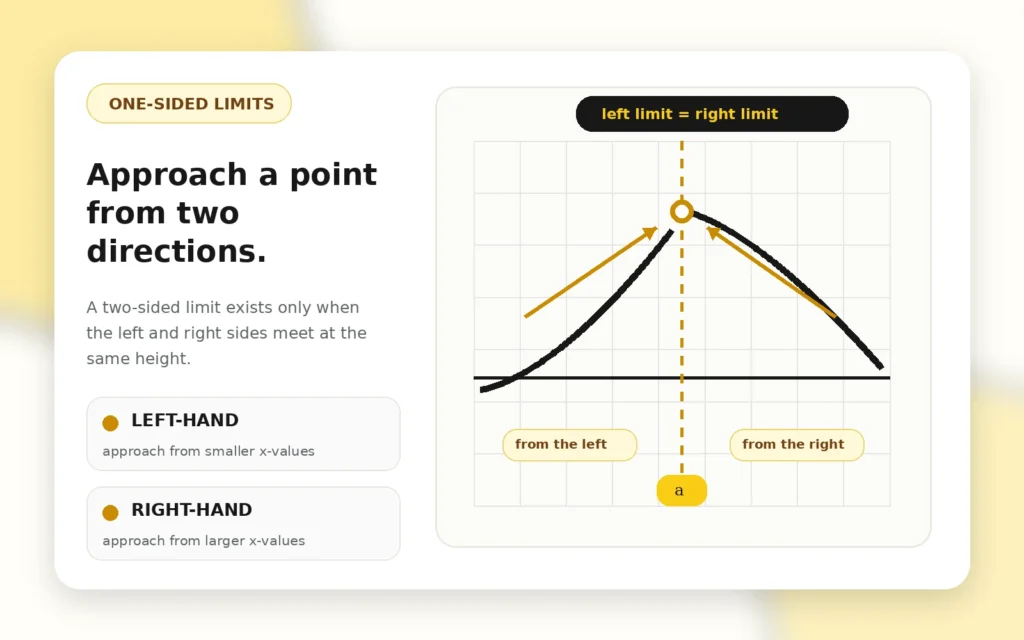
A two-sided limit exists only when both directions approach the same output. When the left side and right side disagree, report that the two-sided limit does not exist and keep the one-sided answers separate.
Worked Examples
Factoring example
lim x→2 (x² − 4)/(x − 2)
Factor x² − 4 into (x − 2)(x + 2), cancel the matching factor for nearby x-values, and evaluate x + 2 at 2. The limit is 4.
Trigonometric example
lim x→0 sin(x)/x
Using radians, values from both sides move toward 1. This is one of the standard trigonometric limits used in calculus.
Limit that does not exist
lim x→0 |x|/x
The left-hand value approaches −1 and the right-hand value approaches 1. Since they differ, there is no two-sided limit.
Limits at Infinity
For an infinity limit, the question is about end behavior rather than one nearby finite point. With rational functions, compare the largest powers. When the numerator and denominator have the same degree, the ratio of their leading coefficients often gives the horizontal limit.
Common Mistakes
- Treating 0/0 as the final answer instead of an indeterminate form.
- Checking only the left or right side for a two-sided limit.
- Using degrees for a trigonometric limit that assumes radians.
- Reading one table row instead of watching the pattern across several rows.
- Assuming every large value means the same positive or negative infinity behavior.
A Note About Numerical Answers
The tool estimates behavior by testing values close to the target. That is useful for homework checks and graph intuition, but it is not a replacement for symbolic algebra in advanced problems. When a result looks unstable, simplify the expression and compare both one-sided limits.