Long Division Calculator
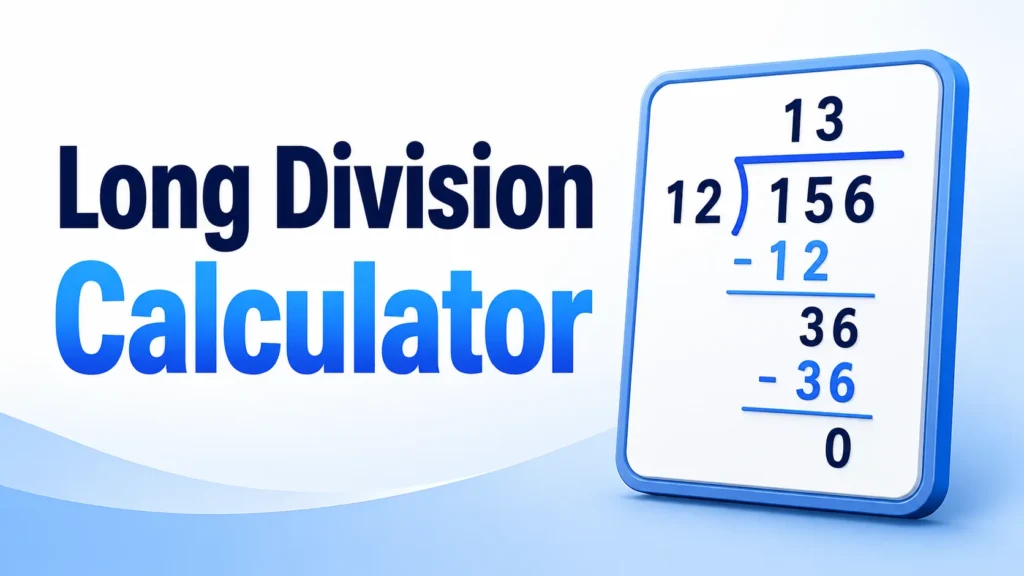
Use the Long Division Calculator to divide whole numbers or decimals and view the quotient, remainder, decimal answer, mixed number, and working steps.
Long Division Calculator
Enter the dividend and divisor below. Choose the details you want to see, then calculate the answer without leaving the page.
Long Division Result
Long Division Visual Format
Step-by-Step Explanation
How to use the Long Division Calculator
Start with the number you want to split, called the dividend. Put the number you are dividing by in the divisor box. The result area then separates the answer into the quotient, remainder, decimal form, and mixed-number form, so you can use the version your lesson asks for.
- Enter the dividend.
- Enter a non-zero divisor.
- Choose the result details.
- Calculate and check the work.
What the answer means
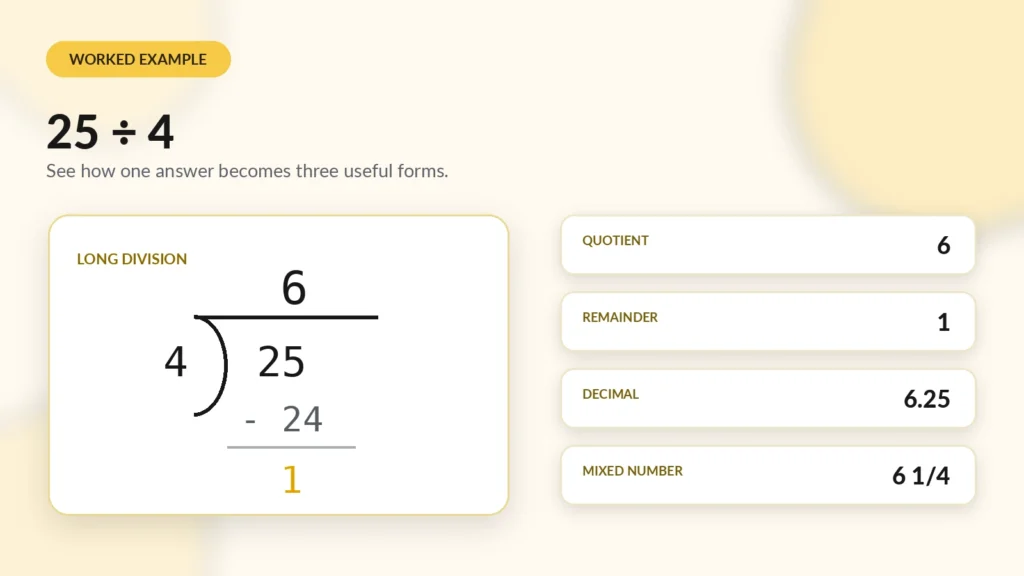
The quotient tells you how many complete times the divisor fits into the dividend. The remainder is what is left after those complete groups are taken out. A remainder of zero means the division is exact.
Four fits into 25 six complete times because 6 × 4 = 24. One is left, so the answer is 6 R 1. The same value can be written as 6.25 or 6 1/4.
The long division rhythm
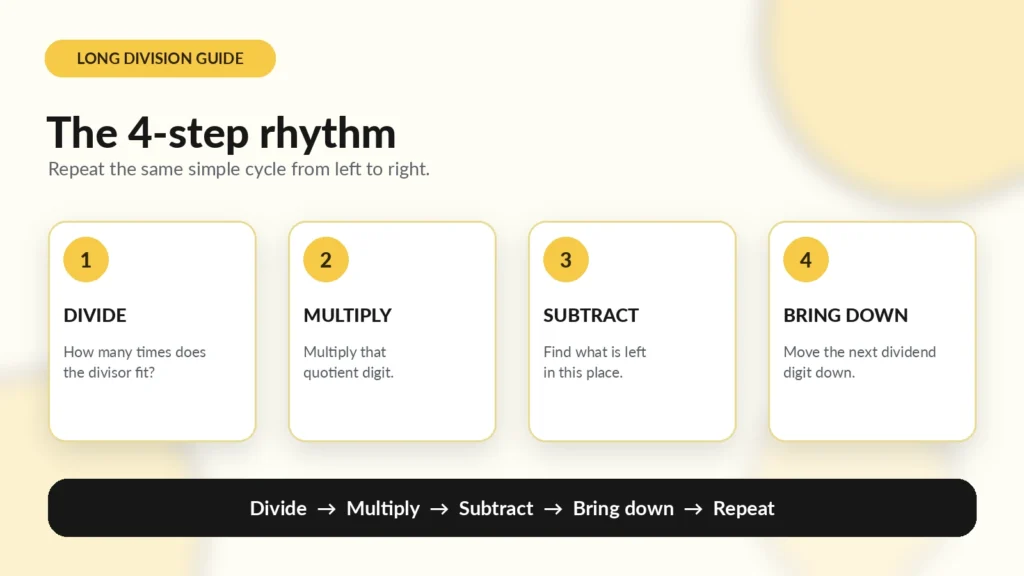
Long division feels easier when you repeat the same small cycle: divide, multiply, subtract, bring down. Work from left to right. After subtracting, bring down the next digit and repeat until there are no digits left.
This calculator follows that classroom method for whole numbers. It also adds a short check at the end: quotient × divisor + remainder should equal the dividend.
Remainders, decimals, and mixed numbers
A remainder is often the best format when you are counting complete objects. A decimal is useful for measurement, money, and many science problems. A mixed number is useful when your class is working with fractions. The calculator gives you all three where they apply, so you do not need to run the same problem several times.
Common mistakes to watch for
- Putting the dividend and divisor in the opposite boxes.
- Forgetting to bring down the next digit.
- Using a multiplication fact that is larger than the current number.
- Subtracting incorrectly before the next step.
- Leaving out a zero in the quotient when a place value needs one.
- Trying to divide by zero.
A practical way to learn faster
Use the tool as a checker, not only as an answer machine. Try the problem on paper first, compare each line with the displayed steps, and correct the first place where your work changes. That habit makes it much easier to spot whether the issue came from division, multiplication, or subtraction.
Frequently asked questions
What does the Long Division Calculator show?
It shows the whole-number quotient, any remainder, a decimal answer, a mixed-number answer, and the calculation steps you selected.
Can I divide numbers that have decimals?
Yes. Enter decimal values in either box. For a traditional digit-by-digit school method, whole-number inputs give the clearest step display.
Why is division by zero blocked?
A number cannot be divided by zero, so the calculator stops the calculation and asks you to enter another divisor.
How can I check a remainder?
Multiply the quotient by the divisor, then add the remainder. The result should equal the original dividend.
Does this calculator work on a phone?
Yes. The inputs, buttons, result cards, steps, and reading sections adjust for phones and tablets.
Last updated: