US retirement planning tool

Roth IRA Calculator

This Roth IRA Calculator helps you estimate Roth IRA eligibility, maximum contribution, monthly savings amount, future retirement value, total contributions, investment growth, and inflation-adjusted value based on your age, income, filing status, and savings plan.

2025 and 2026 limits Income phase-out estimate Future value projection No signup required

Roth IRA Contribution & Growth Calculator

Enter your details below to estimate direct Roth IRA eligibility, contribution room, monthly contribution amount, and projected retirement balance.

Basic Details

Contribution Details

The projection uses the lower of your planned amount and your estimated allowed contribution.

Investment Assumptions

Optional Comparison

Roth IRA Growth Chart

This simple chart shows the estimated year-by-year balance from your current age to retirement.

Year-by-Year Projection Table

Review the estimated beginning balance, annual contribution, investment growth, and ending balance for each year.

Year Age Beginning Balance Contribution Growth Ending Balance
Your projection will appear here after calculation.

What Is a Roth IRA?

A Roth IRA is an individual retirement account funded with after-tax dollars. Unlike some retirement accounts that may provide a tax deduction today, a Roth IRA is designed to create the potential for tax-free qualified withdrawals in retirement. This can make a Roth IRA attractive for US savers who want flexibility, long-term growth, and the possibility of tax-free retirement income.

A Roth IRA can be used by younger workers, families, self-directed investors, and people who want to supplement an employer retirement plan such as a 401(k). Because contribution eligibility depends on filing status, earned income, and Modified Adjusted Gross Income, a Roth IRA calculator can help estimate whether you may qualify for a full contribution, a reduced contribution, or no direct Roth IRA contribution for the selected year.

How This Roth IRA Calculator Works

This roth ira calculator combines a Roth IRA contribution calculator, Roth IRA income limit calculator, Roth IRA phase out calculator, Roth IRA growth calculator, and Roth IRA future value calculator in one page. It first checks the selected tax year, your age, filing status, MAGI, and earned income. Then it estimates your allowed direct Roth IRA contribution based on the annual IRA limit, age 50+ catch-up amount, income phase-out rules, and earned income limit.

After estimating eligibility, the calculator projects your Roth IRA retirement value from your current age to your retirement age. It tracks beginning balance, annual contribution, investment growth, ending balance, total contributions, inflation-adjusted value, and progress toward your desired retirement balance. If the taxable comparison option is enabled, it also provides a rough Roth IRA vs taxable account calculator estimate using a tax-drag assumption.

Roth IRA Contribution Limits

Roth IRA contribution limits are annual limits that apply across IRA contributions. For 2025, this calculator uses a standard IRA contribution limit of $7,000 and an age 50+ catch-up contribution of $1,000, for a total of $8,000 for eligible people age 50 or older. For 2026, this Roth IRA calculator uses a standard IRA contribution limit of $7,500 and an age 50+ catch-up contribution of $1,100, for a total of $8,600 for eligible people age 50 or older.

The maximum contribution may also be limited by earned income. For example, if your earned income is lower than the annual limit, your allowed contribution generally cannot exceed your earned income. This is why the calculator asks for earned income separately from MAGI.

Roth IRA Income Limits

Roth IRA eligibility depends heavily on filing status and Modified Adjusted Gross Income. A single filer or head of household may have a different income range than a married couple filing jointly. A married person filing separately has a very narrow phase-out range, which is why this roth ira eligibility calculator applies a special $0 to $10,000 range for married filing separately.

This roth ira calculator 2026 and roth ira calculator 2025 uses the income limits entered in the calculator logic above. If your MAGI is below the lower threshold for your filing status, the calculator shows an estimate for a full contribution. If your MAGI falls inside the phase-out range, the tool estimates a reduced contribution. If your MAGI is at or above the upper threshold, it shows that you are not eligible for a direct Roth IRA contribution.

Roth IRA Phase-Out Explained

The Roth IRA phase-out is the income range where your direct Roth IRA contribution begins to shrink. Instead of switching immediately from a full contribution to zero, the contribution amount is gradually reduced as MAGI moves through the phase-out range. This is why a roth ira phase out calculator can be helpful for people near the income limits.

In this template, the reduced contribution is rounded down to the nearest $10. The estimate is useful for planning, but users should confirm exact IRS rules and calculations before making a final contribution, especially if they are close to the income thresholds or have complex tax situations.

How Much Can I Contribute to a Roth IRA?

The answer depends on the tax year, age, filing status, MAGI, earned income, and how much has already been contributed during the year. This roth ira max contribution calculator estimates your maximum allowed direct Roth IRA contribution, subtracts the amount already contributed, and shows remaining contribution room.

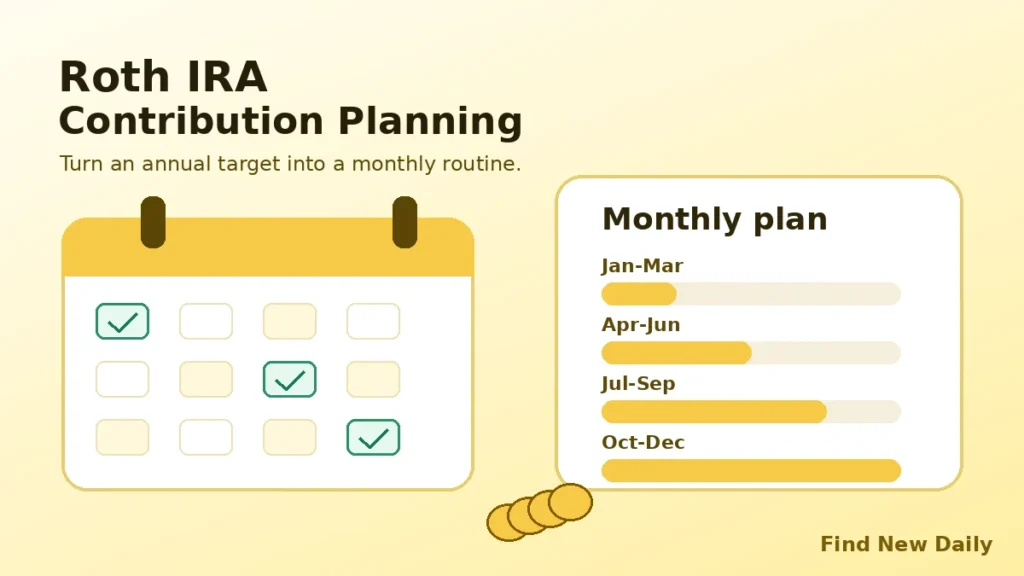
The calculator also divides remaining contribution room by 12 to estimate a monthly amount needed to max out over a full year. If you start contributing late in the year, you may need to contribute more per month to reach your limit before the annual deadline.

Roth IRA Growth Example

A Roth IRA growth calculator helps show why time and consistency matter. For example, a 30-year-old who contributes regularly until age 65 may see a significant portion of the final balance come from investment growth rather than contributions alone. The exact result depends on annual returns, contribution amounts, future limits, and market performance.

This calculator uses a year-by-year projection. Each year starts with the beginning balance, adds the annual contribution, applies the expected annual return, and records the ending balance. It also estimates inflation-adjusted value so users can compare a future dollar amount with today’s purchasing power.

Roth IRA vs Traditional IRA

A Roth IRA is usually funded with after-tax contributions, and qualified withdrawals may be tax-free. A Traditional IRA may offer a current tax deduction depending on your situation, but withdrawals are usually taxed as ordinary income. The better option depends on current tax rate, expected future tax rate, eligibility, income, and retirement goals.

Roth IRA vs Taxable Brokerage Account

A taxable brokerage account can be flexible and does not have the same contribution limits as a Roth IRA, but dividends, interest, and capital gains may create taxes. A Roth IRA may offer tax-free qualified withdrawals, making it valuable for long-term retirement savings. This calculator’s taxable comparison is only a rough estimate.

Who Should Use a Roth IRA Calculator?

A Roth IRA retirement calculator may be useful for anyone who wants to estimate retirement savings from a Roth IRA. It can help new investors, young professionals, married couples, people near the Roth IRA income limit, workers age 50 or older who may qualify for catch-up contributions, and people comparing a Roth IRA with taxable investing.

It can also help users who search for a roth ira monthly contribution calculator because it shows a suggested monthly amount to fill remaining contribution room. People considering a backdoor Roth IRA may also use this page as a starting point, but a backdoor roth ira calculator or strategy requires special care because tax rules, pro-rata rules, existing IRA balances, and reporting requirements can affect the decision.

Tips to Maximize Your Roth IRA

  • Start early so your investments have more time to compound.
  • Contribute monthly to make saving more consistent and manageable.
  • Try to max out your Roth IRA if it fits your budget and overall financial plan.
  • Review Roth IRA income limits every year because phase-out ranges can change.
  • Avoid excess contributions by tracking what you already contributed.
  • Reinvest dividends when appropriate so your account can continue compounding.
  • Keep a long-term investment plan instead of reacting to short-term market moves.
  • Consider professional tax advice before using advanced strategies such as a backdoor Roth IRA.
This Roth IRA Calculator is for educational and informational purposes only. It does not provide financial, investment, tax, or legal advice. Roth IRA contribution limits, income limits, tax rules, and phase-out ranges may change. Please confirm current IRS rules and speak with a qualified tax or financial professional before making financial decisions.

Frequently Asked Questions

These common questions explain how to use the Roth IRA Calculator and understand contribution limits, eligibility, phase-outs, and retirement projections.

A Roth IRA calculator is a planning tool that estimates eligibility, contribution room, future account value, investment growth, and inflation-adjusted retirement value based on your inputs.

Your contribution depends on the annual IRA limit, your age, earned income, filing status, MAGI, and any amount already contributed for the year.

This calculator uses a 2026 standard IRA contribution limit of $7,500 and an age 50+ catch-up amount of $1,100, for a total of $8,600 for eligible users age 50 or older.

For 2026, this calculator uses phase-out ranges of $153,000 to $168,000 for single and head of household filers, $242,000 to $252,000 for married filing jointly and qualifying widow(er), and $0 to $10,000 for married filing separately.

If your MAGI is above the upper limit for your filing status, you may not be eligible for a direct Roth IRA contribution. Some people consider a backdoor Roth IRA strategy, but that requires careful tax review.

Excess Roth IRA contributions may create tax penalties if not corrected properly. If you believe you overcontributed, speak with a tax professional or IRA provider as soon as possible.

A Roth IRA may be better if you value tax-free qualified withdrawals later. A traditional IRA may be better if you need a possible tax deduction now. The right choice depends on your tax situation and retirement plan.

Qualified Roth IRA withdrawals may be tax-free if IRS requirements are met. Rules can vary for earnings, conversions, age, and account holding period.

Roth IRA contributions can generally be withdrawn more flexibly than earnings, but users should confirm current rules before taking withdrawals.

A simple approach is to divide your remaining contribution room by the number of months you plan to contribute. This calculator uses 12 months by default for a full-year estimate.

Yes. The calculator estimates inflation-adjusted value by discounting the projected future balance using your selected inflation rate and years until retirement.

No. This calculator is for educational and informational purposes only and does not provide financial, investment, tax, or legal advice.