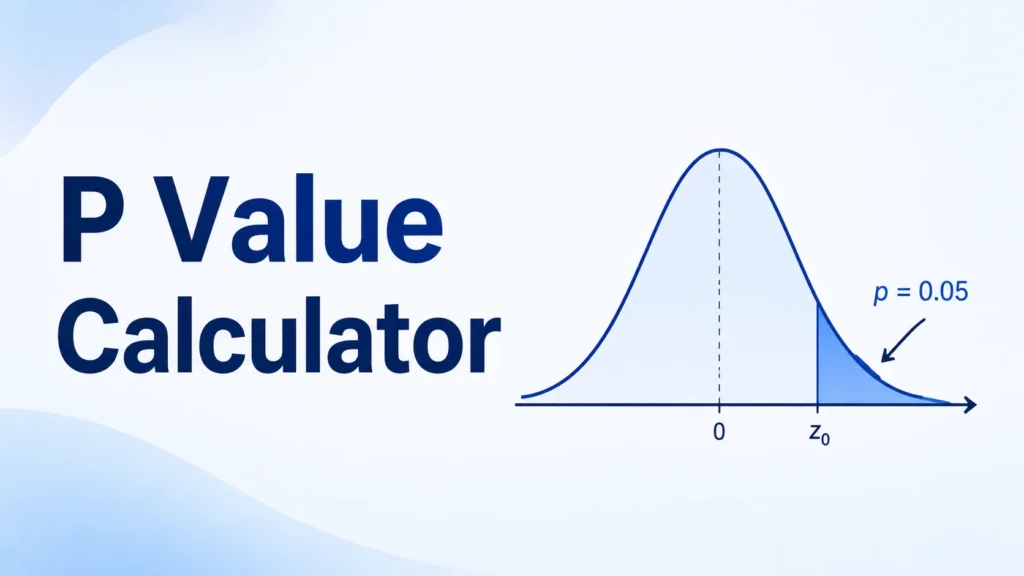
Calculate and interpret statistical significance with P Value Calculator. Choose a test, enter your values, and get a clear p-value decision with step-by-step details.
Updated July 12, 2026•By Abhishek
Result Summary
0.0000
Step-by-Step Calculation
Disclaimer: P Value Calculator is for educational and informational purposes only. It provides approximate statistical estimates based on the values entered. It should not replace professional statistical, academic, medical, legal, or financial advice.
About P Value Calculator
This page keeps the calculator at the top so you can get an answer without scrolling through a long article first. The explanation below is there when you need it, and the longer guide stays collapsed until you choose to open it.
How to Read Your P Value Calculator Result
A p-value helps you judge how unusual your result would be if there were no real effect or difference. It is not a score for whether an idea is true. Think of it as one piece of evidence that should be read together with sample size, effect size, test choice, and data quality.
Small p-value
Your result is less compatible with the null hypothesis.
Large p-value
You do not have enough evidence to reject the null hypothesis.
Close to alpha
Treat the result carefully and review assumptions before deciding.
Where the p-value comes from
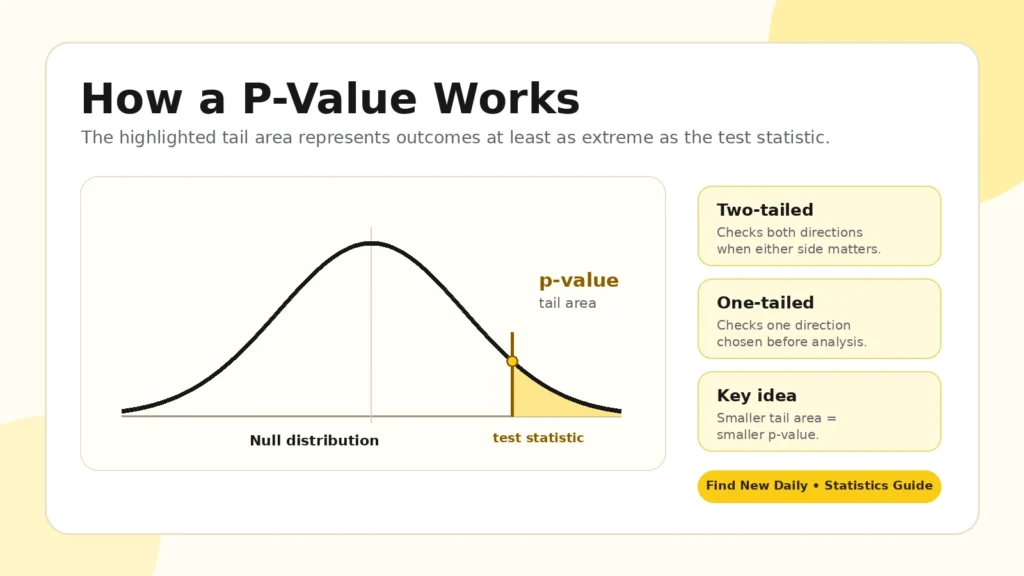
The shaded tail area represents outcomes at least as extreme as the test statistic. A two-tailed test checks both sides of the distribution, while a one-tailed test checks only the direction chosen before looking at the result.
Read the complete p-value guide
How to use P Value Calculator
Choose Beginner Mode for guided test selection, or Advanced Mode when you already know the test.
Enter the test statistic or the requested sample values.
Select the tail type and significance level. A two-tailed test is the safer default when either direction matters.
Calculate the result, then compare the p-value with alpha.
Read the decision and the step-by-step explanation before using the result.
What does p < 0.05 mean?
When the p-value is below 0.05, the result is commonly described as statistically significant at the 5% level. That does not prove the alternative hypothesis, and it does not tell you whether the effect is large or useful. A tiny effect can become statistically significant in a very large sample.
One-tailed and two-tailed tests
A one-tailed test is used only when the direction was decided in advance and an effect in the opposite direction would not support the claim. A two-tailed test checks both directions and is common when you simply want to know whether two values differ.
Choosing a test
Z test: useful for known z scores and many large-sample proportion problems.
T test: common for means when population variability is unknown.
Chi-square test: used for counts, categories, goodness-of-fit, and independence.
F test: used for variance-based comparisons and related models.
A/B test: compares two conversion rates using a two-proportion z test.
Correlation test: checks whether a sample correlation differs from zero.
A simple decision rule
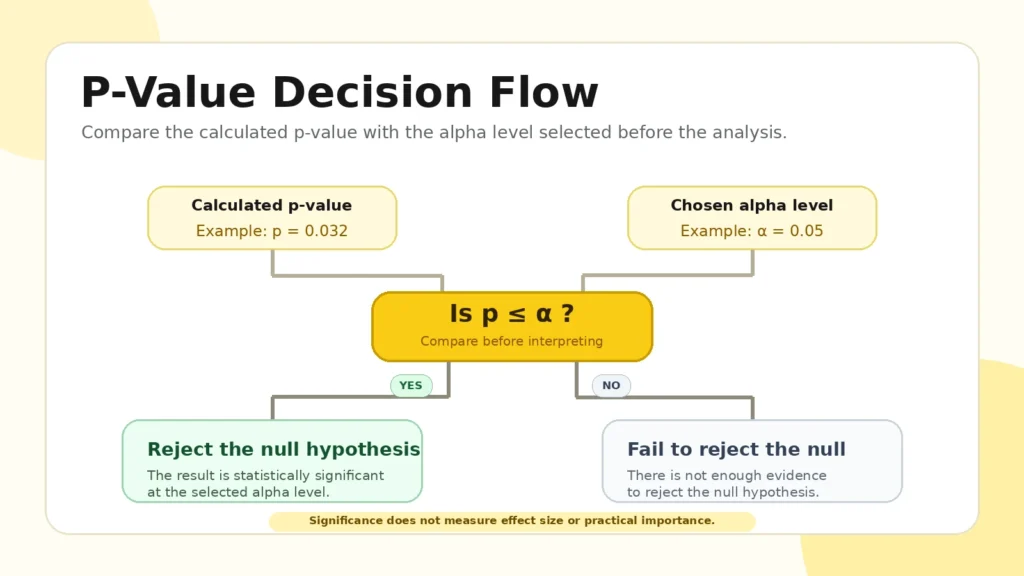
Compare the calculated p-value with the alpha level you selected before the analysis. When p is less than or equal to alpha, reject the null hypothesis. Otherwise, fail to reject it. “Fail to reject” is not the same as proving the null hypothesis.
Common interpretation mistakes
A p-value does not measure the size or importance of an effect.
Statistical significance does not automatically mean practical significance.
A result just above 0.05 is not necessarily “no effect,” and a result just below 0.05 is not automatically strong evidence.
Running many tests increases the chance of finding a small p-value by accident.
The result can be misleading when the wrong test or poor-quality data is used.
P Value Calculator FAQs
Open only the question you need. All answers are included in the page HTML, so the section remains lightweight and accessible.
What is a p-value?
A p-value estimates how likely your observed result, or a more extreme result, would be if the null hypothesis were true.
What does p < 0.05 mean?
It means the p-value is below the commonly used 0.05 significance level. The result may be called statistically significant, but this does not prove the claim or measure effect size.
Should I use a one-tailed or two-tailed test?
Use a two-tailed test when an effect in either direction matters. Use a one-tailed test only when the direction was chosen before analysing the data and the opposite direction would not support the claim.
Can this calculator handle t tests and z tests?
Yes. Select the appropriate test, enter the statistic and any required degrees of freedom, then choose the tail type and alpha level.
How does the A/B test option work?
It compares the conversion rates of two groups using a pooled two-proportion z test and reports the estimated p-value and significance decision.
Does a large p-value prove the null hypothesis?
No. A large p-value means the data does not provide enough evidence to reject the null hypothesis. It does not prove that the null hypothesis is true.
Is this result suitable for a research publication?
The calculator provides educational estimates. For publication, medical, legal, financial, or high-stakes work, verify the analysis with professional statistical software or a qualified statistician.