Use the Right Triangle Calculator to calculate missing sides, hypotenuse, angles, area, perimeter, roof pitch, ladder length, ramp length, and diagonal distance with clear steps.
Right Triangle Calculator
Enter the measurements you already know. Decimals and fractions such as 4.5, 4 1/2, 7/8, and 12 3/8 are supported.
Free · With steps
Use for a triangle leg, roof rise, wall height, ramp rise, or room length.
Use for a triangle leg, roof run, distance from wall, ramp run, or room width.
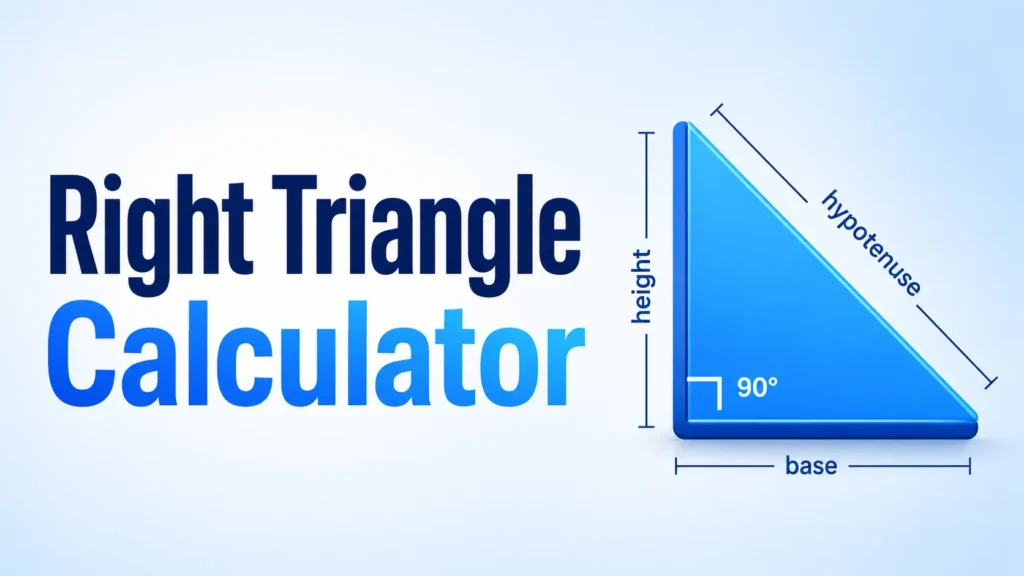
The longest side, opposite the 90° angle.
One acute angle in degrees.
The other acute angle. Angle A + Angle B = 90°.
Triangle area. Units are squared.
Optional for ramp calculations when run is unknown.
Try an example:
Results
Step-by-step solution
Right Triangle Calculator — enter your known measurements above to begin.
A practical guide to this right triangle calculator
You do not need to fill every box. Start by choosing what you want to calculate, then enter only the measurements you already know. For most everyday problems, two sides are enough. The result area shows the missing values and the main calculation used.
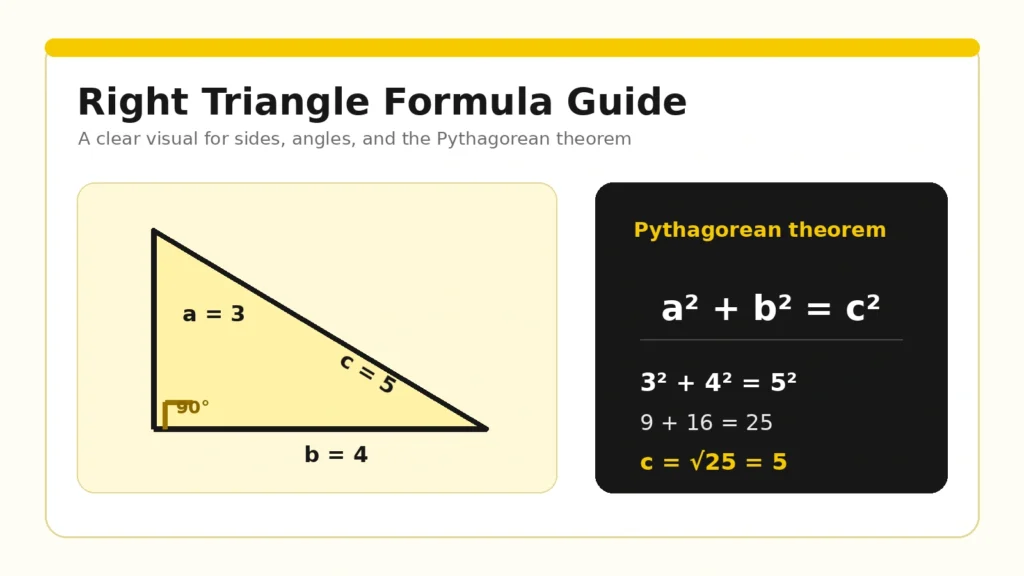
The familiar formula is:
a² + b² = c²
Here, a and b are the two shorter sides that meet at the right angle. c is the hypotenuse—the longest side. The same relationship is useful for a room diagonal, a roof rafter, a ladder against a wall, or the sloping surface of a ramp.
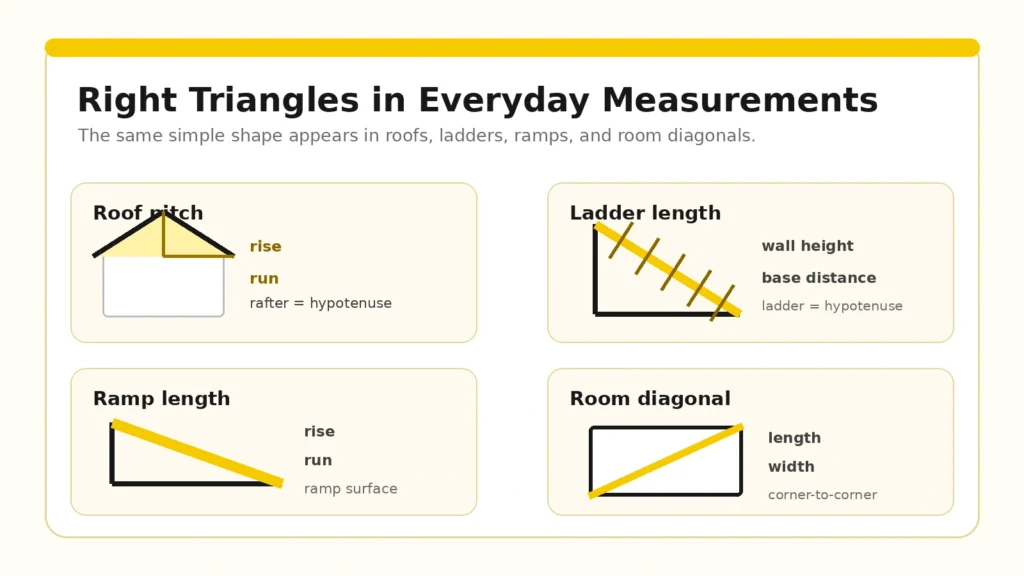
A visual reminder of the Pythagorean theorem and the classic 3–4–5 triangle.Common real-life uses: roof pitch, ladder length, ramp length, and diagonal distance.
Read more about formulas, examples, and units
How the main calculations work
Finding the hypotenuse
Square the two legs, add the results, and take the square root. With sides 3 and 4, the calculation is √(3² + 4²) = √25 = 5.
Finding a missing leg
When the hypotenuse and one leg are known, subtract the known leg’s square from the hypotenuse’s square, then take the square root. For example, a hypotenuse of 13 and a leg of 5 gives a missing leg of 12.
Angles, area, and perimeter
The two acute angles always add up to 90°. The calculator uses basic trigonometry to find them. Area is ½ × base × height, while perimeter is the sum of all three sides.
Everyday examples
Room diagonal: Enter the room length and width to estimate the corner-to-corner distance.
Roof pitch: Enter rise and run to estimate the rafter length, angle, and slope percentage.
Ladder: Enter wall height and the distance of the ladder’s base from the wall.
Ramp: Enter rise and run, or rise and slope percentage, to estimate ramp length.
For construction, accessibility, or safety-critical work, use the result as an estimate and verify it against current local codes and on-site measurements.
Fractions and measurement units
The input boxes accept whole numbers, decimals, simple fractions, and mixed fractions. Examples include 8, 4.5, 7/8, and 12 3/8. Keep all side measurements in the same unit before calculating.
Right Triangle Calculator FAQ
What values do I need to enter?
For most calculations, enter any two known sides. You can also use one acute angle with one side, or area with one leg in the supported modes.
Can I enter fractions?
Yes. The calculator accepts values such as 7/8, 4 1/2, and 12 3/8, as well as regular decimals.
Which side is the hypotenuse?
The hypotenuse is the longest side. It sits opposite the 90-degree angle.
How is a room diagonal calculated?
The room length and width act as the two legs of a right triangle. The diagonal is found with √(length² + width²).
Can this tool estimate roof pitch?
Yes. Enter rise and run to estimate the roof angle, slope percentage, and rafter length.
Does it work on mobile?
Yes. The form, result cards, images, and expandable reading sections adapt to smaller screens.