Simplify Calculator
Simplify Calculator With Steps
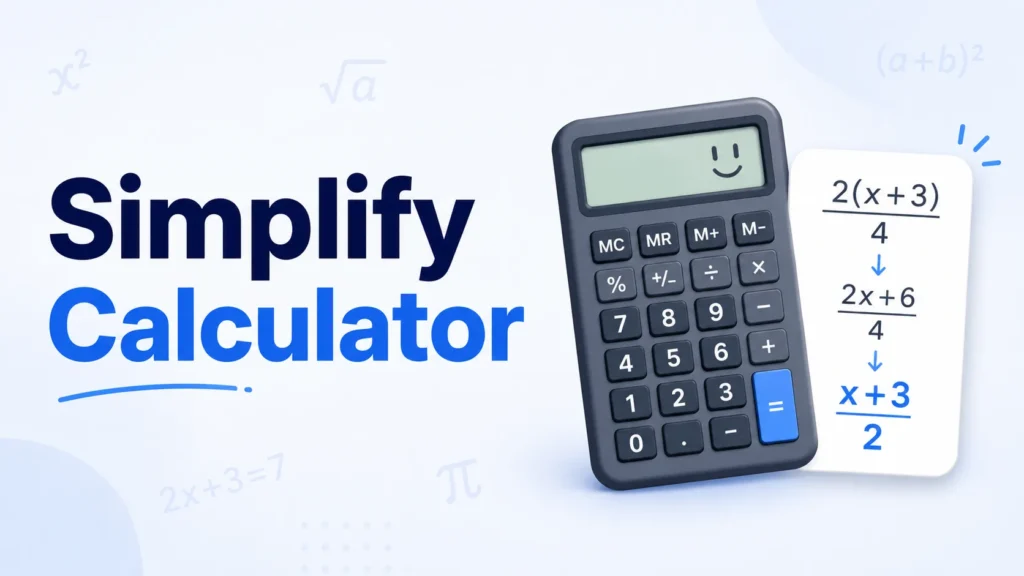
Use this simplify calculator to simplify expressions, fractions, radicals, exponents, and basic algebra problems. It is designed for students, parents, and teachers who want a fast math simplifier with clear steps.
Clickable Examples
Final Answer
Step-by-Step Solution
What Is a Simplify Calculator?
A simplify calculator is an online math tool that rewrites a math expression in a cleaner, shorter, or easier-to-read form without changing its value. This simplify calculator helps with common school math topics, including simplifying expressions, reducing fractions, simplifying radicals, simplifying exponents, and combining like terms.
Students often search for a simplify calculator with steps because they do not just want the final answer. They also want to understand how the answer was found. This page is designed to work as a beginner-friendly math simplifier, expression simplifier, algebra simplifier, fraction simplifier, radical simplifier, and simplify exponents calculator.
How to Use the Simplify Calculator
- Choose the calculator mode that matches your problem.
- Type your expression, fraction, radical, or exponent problem into the input box.
- Click the Simplify button.
- Read the final answer and the step-by-step explanation.
- Use the Copy Answer button if you want to save the result.
The default mode is the simplify expression calculator. You can switch tabs to use the simplify fractions calculator, simplify radicals calculator, simplify exponents calculator, or basic algebra simplifier.
What Does Simplifying Mean in Math?
Simplifying means rewriting a number, expression, or algebra problem in a simpler form while keeping the same value. For example, 2x + 3x can be simplified to 5x. The expression looks shorter, but it still means the same thing.
Another example is 24/36. This fraction can be reduced to 2/3. The fraction is simpler, but the value has not changed. A simplify calculator helps students see this process clearly.
How to Simplify Expressions
To simplify expressions, look for parts that can be combined or rewritten. In algebra, this usually means combining like terms, removing unnecessary parentheses, and using the distributive property when needed.
For example, 4a + 2b + 3a becomes 7a + 2b because 4a and 3a are like terms. The term 2b stays separate because it has a different variable.
How to Combine Like Terms
Like terms have the same variable part. For example, 2x and 3x are like terms because both include x. You can add their coefficients: 2 + 3 = 5, so 2x + 3x = 5x.
Terms like 4a and 2b are not like terms because the variables are different. A combine like terms calculator is helpful when an expression has several terms and students need to organize them.
How to Simplify Fractions
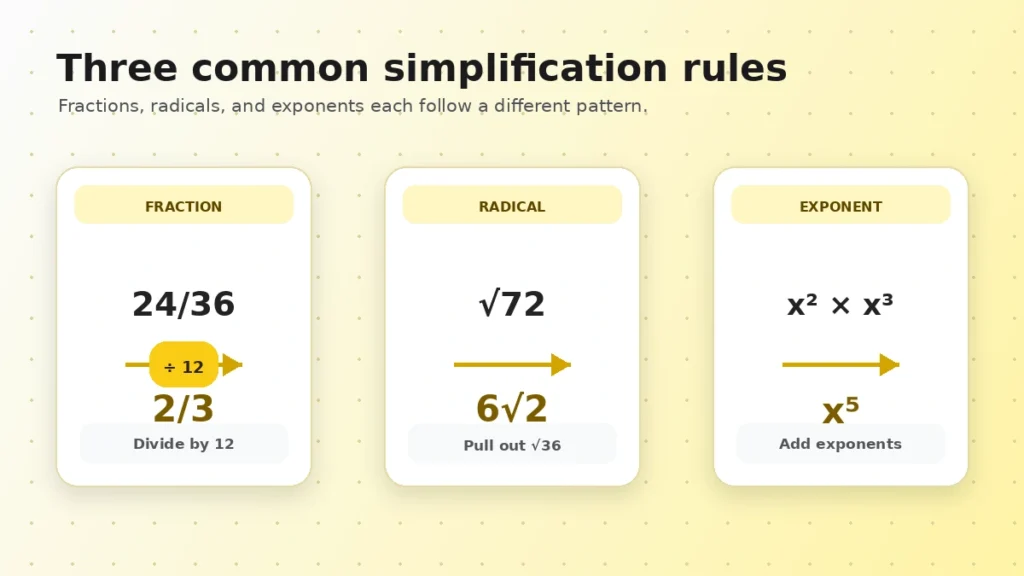
To simplify fractions, divide the numerator and denominator by their greatest common factor, also called the GCF. For example, the GCF of 24 and 36 is 12. Dividing both numbers by 12 gives 24/36 = 2/3.
This simplify fractions calculator also shows a decimal value and, when useful, a mixed number for improper fractions. Reducing fractions helps make answers easier to compare and understand.
How to Simplify Radicals
To simplify radicals, look for the largest perfect square factor inside the square root. For example, sqrt(50) can be written as sqrt(25 × 2). Since sqrt(25) = 5, the simplified radical form is 5sqrt(2).
Other examples include sqrt(72) = 6sqrt(2) and sqrt(12) = 2sqrt(3). A simplify radicals calculator is useful when students are learning square roots and perfect square factors.
How to Simplify Exponents
Exponent rules help simplify powers. For example, the product rule says that when multiplying powers with the same base, add the exponents. So x^2 × x^3 = x^5.
The quotient rule says to subtract exponents when dividing powers with the same base. The power rule says to multiply exponents when a power is raised to another power. This simplify exponents calculator explains these common rules in simple language.
Simplifying Expressions With Parentheses
When an expression has parentheses, you may need to use the distributive property. For example, 2(x + 5) means 2 × x + 2 × 5, so the simplified answer is 2x + 10.
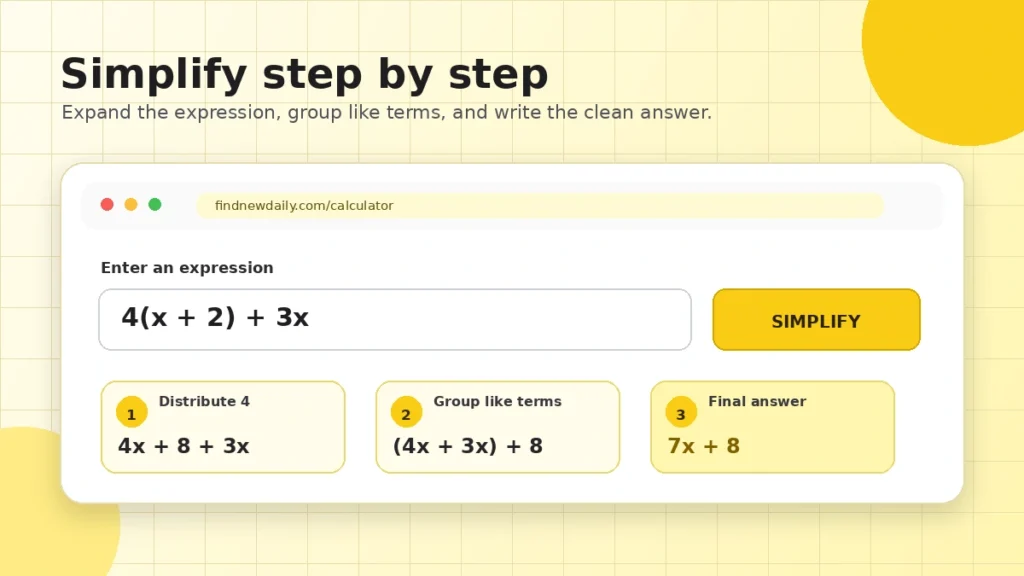
Another example is 4(x + 2) + 3x. First distribute 4 to get 4x + 8 + 3x. Then combine like terms to get 7x + 8.
Simplify Calculator Examples
| Original Problem | Simplified Answer | Rule Used |
|---|---|---|
| 2x + 3x | 5x | Combine like terms |
| 4a + 2b + 3a | 7a + 2b | Combine like terms |
| 24/36 | 2/3 | Greatest common factor |
| sqrt(50) | 5sqrt(2) | Perfect square factor |
| x^2 × x^3 | x^5 | Product rule of exponents |
Common Simplifying Rules
- Combine like terms: Add or subtract terms with the same variable part.
- Distributive property: Multiply the outside number by each term inside parentheses.
- Fraction reduction: Divide the numerator and denominator by the GCF.
- Radical simplification: Pull perfect square factors out of the square root.
- Product rule: When multiplying powers with the same base, add exponents.
- Quotient rule: When dividing powers with the same base, subtract exponents.
- Power rule: When raising a power to a power, multiply exponents.
- Zero exponent rule: Any nonzero base raised to the zero power equals 1.
- Negative exponent rule: A negative exponent can be rewritten as a reciprocal.
Why Step-by-Step Simplification Helps Students
A simplify calculator with steps is helpful because it shows the reasoning behind the answer. Many students can copy a final answer, but they still need to learn why that answer is correct. Step-by-step simplification helps students build confidence, check homework, and prepare for quizzes and tests.
Parents and teachers can also use this math simplifier to explain common algebra rules in a clear way. Seeing each step makes it easier to find mistakes and understand the structure of an expression.
Difference Between Simplifying and Solving
Simplifying and solving are related, but they are not the same. Simplifying rewrites an expression in a cleaner form without changing its value. Solving usually means finding the value of a variable.
For example, simplifying 2x + 3x gives 5x. But solving 2x + 3 = 11 means finding the value of x. In that case, x = 4. This page is mainly an expression simplifier, not a full equation solver.
When to Use This Calculator
You can use this simplify calculator when you need help with math homework, algebra practice, test review, fraction reduction, radical simplification, or exponent rules. It is useful for middle school math, high school algebra, college prep review, and basic math tutoring.
This calculator is best for simple and beginner-friendly expressions. Very advanced expressions may require a more powerful symbolic algebra system, but this tool is fast, clean, and easy to use for common classroom problems.
Tips for Checking Your Answer
- Make sure like terms have the same variable part before combining them.
- Check signs carefully when subtracting terms.
- For fractions, confirm that the numerator and denominator have no common factor greater than 1.
- For radicals, look for the largest perfect square factor.
- For exponents, check whether the problem uses multiplication, division, a power, zero exponent, or negative exponent.
- Substitute a simple number for the variable to see whether the original and simplified expressions have the same value.
Frequently Asked Questions
What is a simplify calculator?
A simplify calculator is a math tool that rewrites expressions, fractions, radicals, or exponents in a cleaner form. This simplify calculator with steps helps students understand the process, not just the final answer.
How do I simplify an expression?
To simplify an expression, combine like terms, remove unnecessary parentheses, and use basic math rules such as the distributive property. For example, 2x + 3x simplifies to 5x.
Can this calculator simplify fractions?
Yes. The simplify fractions calculator reduces fractions to lowest terms by finding the greatest common factor of the numerator and denominator.
Can this calculator simplify radicals?
Yes. The simplify radicals calculator can simplify square roots such as sqrt(50), sqrt(72), and sqrt(12) by factoring out perfect squares.
Can this calculator simplify exponents?
Yes. The simplify exponents calculator supports common exponent rules such as the product rule, quotient rule, power rule, zero exponent rule, and negative exponent rule.
What are like terms?
Like terms are terms that have the same variable part. For example, 4x and 7x are like terms, but 4x and 7y are not like terms.
What does combine like terms mean?
Combine like terms means adding or subtracting terms that have the same variable part. For example, 3a + 4a - 2a simplifies to 5a.
Can this calculator show steps?
Yes. This simplify calculator shows step-by-step explanations for many basic expressions, fractions, radicals, exponent rules, and algebra simplification problems.
What is the difference between simplifying and solving?
Simplifying rewrites an expression in a shorter or cleaner form. Solving finds the value of a variable. For example, simplifying 2x + 3x gives 5x, while solving 2x = 10 gives x = 5.
Can I use this calculator for homework?
Yes. Students can use this math simplifier for homework help, checking answers, and learning steps. It is especially useful for basic algebra, fractions, radicals, and exponents.
Is this simplify calculator free?
Yes. This simplify calculator is free to use online and does not require a plugin, signup, or download.
Why is my expression not simplifying?
Your expression may be too complex for this basic algebra simplifier. Try a simpler expression like 2x + 3x, 4(x + 2) + 3x, 24/36, sqrt(72), or x^2 * x^3.