Scientific Notation Calculator

Use this scientific notation calculator to convert a standard number, decimal, E notation value, or scientific notation expression into scientific notation, standard form, E notation, and engineering notation with clear steps.

Clickable examples

Scientific Notation
Standard Form
E Notation
Engineering Notation
Order of Magnitude

Step-by-step explanation

    Recent conversions

      Add, subtract, multiply, or divide numbers written in standard form, scientific notation, or E notation. The answer is shown in scientific notation, standard form, and E notation with a step-by-step solution.

      Clickable examples

      Final Answer
      Standard Form
      E Notation

      Step-by-step solution

        Recent calculations
          Scientific Notation Calculator

          What Is Scientific Notation?

          Scientific notation is a compact way to write very large or very small numbers. Instead of writing every zero, a number is expressed as a coefficient multiplied by a power of 10. A scientific notation calculator is useful when working with astronomy, chemistry, physics, engineering, finance, biology, and everyday math problems where numbers can become difficult to read.

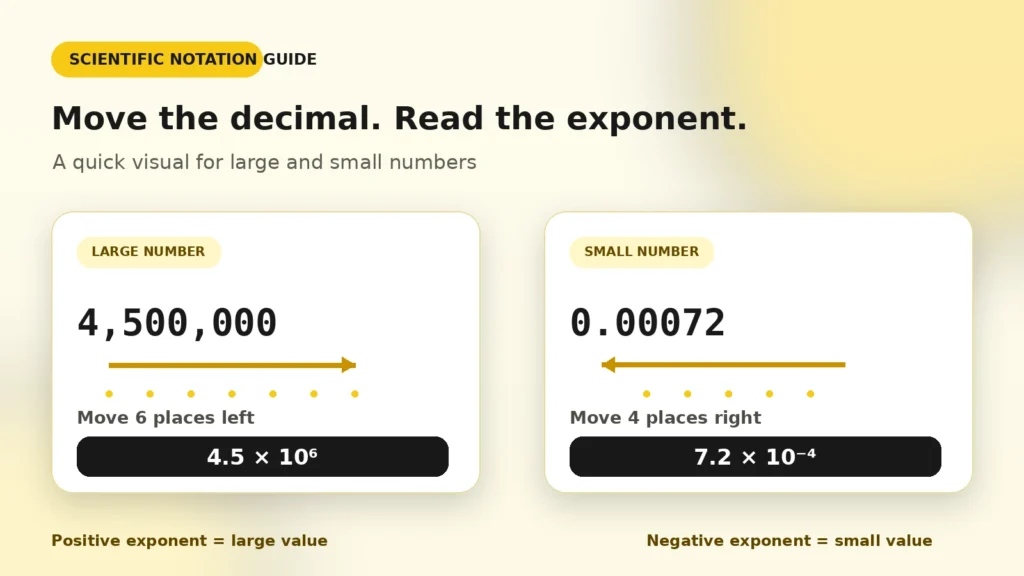
          In proper scientific notation, the coefficient is usually at least 1 and less than 10. For example, 4500000 becomes 4.5 × 10⁶, and 0.00072 becomes 7.2 × 10⁻⁴. This scientific notation converter helps change standard form to scientific notation, scientific notation to standard form, and E notation to a readable math format.

          How to Use the Scientific Notation Calculator

          To use this scientific notation calculator with steps, enter a number such as 4500000, 0.00072, 3.72e8, or 3.72 × 10^8. Choose the conversion type, select significant figures if needed, and click Calculate. The tool will display scientific notation, standard form, E notation, engineering notation, order of magnitude, and a step-by-step explanation.

          For arithmetic, open the Calculate Scientific Notation tab. Enter the first number, choose addition, subtraction, multiplication, or division, then enter the second number. This scientific notation math calculator accepts standard numbers, E notation, and scientific notation expressions using ×, x, or *.

          Scientific Notation Formula

          The general scientific notation formula is:

          a × 10ⁿ

          In this formula, a is the coefficient and n is the exponent. The coefficient is normally written between 1 and 10, while the exponent tells how many places the decimal point moves. Positive exponents are used for large numbers, and negative exponents are used for small decimal numbers.

          How to Convert a Number to Scientific Notation

          To convert a standard number to scientific notation, move the decimal point until only one non-zero digit remains to the left of the decimal. Count the number of decimal places moved. That count becomes the exponent of 10.

          1. Start with the original number.
          2. Move the decimal point to create a coefficient between 1 and 10.
          3. Count how many places the decimal moved.
          4. Use a positive exponent for large numbers and a negative exponent for small decimals.

          Example: 4500000 becomes 4.5 × 10⁶ because the decimal moves 6 places to the left.

          How to Convert Scientific Notation to Standard Form

          To convert scientific notation to standard form, move the decimal point based on the exponent. If the exponent is positive, move the decimal point to the right. If the exponent is negative, move the decimal point to the left.

          Example: 7.2 × 10⁻⁴ becomes 0.00072. This is why a scientific notation to standard form calculator is helpful when checking homework, lab results, or measurement values.

          Scientific Notation with Negative Exponents

          Scientific notation with a negative exponent represents a small number between 0 and 1. The negative exponent tells you how many places to move the decimal point to the left.

          For example, 1.6 × 10⁻⁹ means 0.0000000016. A negative exponent calculator or scientific notation solver can make these conversions easier because it prevents mistakes with decimal placement.

          Scientific Notation Rules

          • The coefficient should usually be at least 1 and less than 10.
          • The base is always 10.
          • The exponent must be a whole number.
          • Positive exponents represent large numbers.
          • Negative exponents represent small decimal numbers.
          • E notation, such as 4.5e6, means the same as 4.5 × 10⁶.

          Adding and Subtracting Scientific Notation

          To add or subtract numbers in scientific notation, it is often easiest to convert both values to the same power of 10 or convert them to standard form first. After adding or subtracting, convert the answer back to scientific notation.

          Example: 3 × 10⁵ + 4 × 10⁵ = 7 × 10⁵. This scientific notation addition calculator shows the standard form step so the process is easier to understand.

          Multiplying and Dividing Scientific Notation

          When multiplying scientific notation, multiply the coefficients and add the exponents. When dividing scientific notation, divide the coefficients and subtract the exponents. The final answer should be adjusted so the coefficient is between 1 and 10.

          Example multiplication: (2 × 10⁴) × (3 × 10⁵) = 6 × 10⁹. A scientific notation multiplication calculator and scientific notation division calculator can quickly show the final answer and the steps.

          Scientific Notation Examples

          Standard Number Scientific Notation
          4500000 4.5 × 10⁶
          0.00072 7.2 × 10⁻⁴
          602200000000000000000000 6.022 × 10²³
          0.0000000016 1.6 × 10⁻⁹

          Real-World Scientific Notation Examples

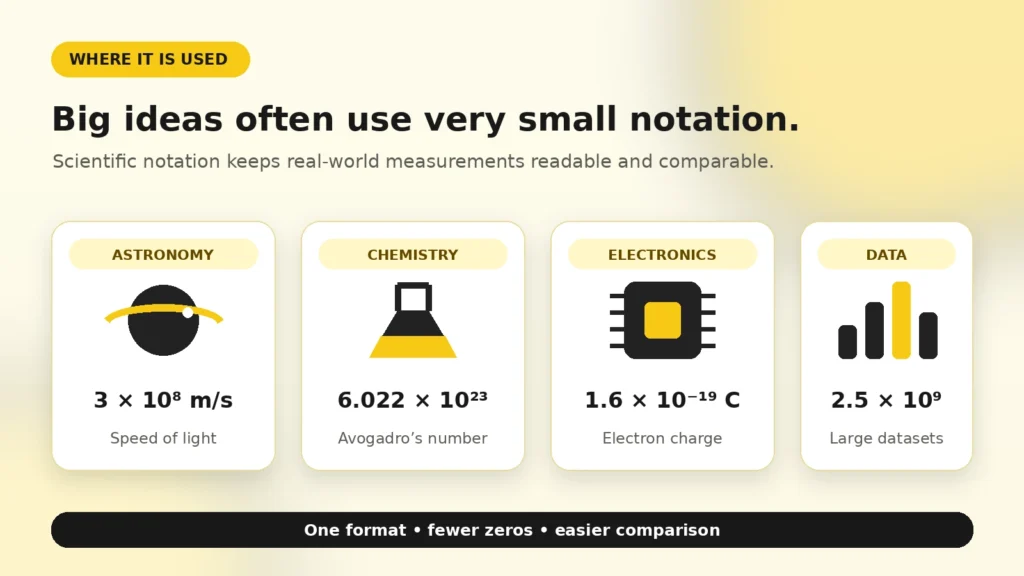
          • Speed of light: 3 × 10⁸ meters per second
          • Avogadro’s number: 6.022 × 10²³
          • Electron charge: 1.602 × 10⁻¹⁹ coulombs
          • Earth mass: 5.972 × 10²⁴ kilograms

          Engineering Notation vs Scientific Notation

          Engineering notation is similar to scientific notation, but the exponent is always a multiple of 3. This makes it useful for engineering units such as kilo, mega, giga, milli, micro, and nano. An engineering notation calculator converts values into powers such as 10³, 10⁶, 10⁹, 10⁻³, 10⁻⁶, and 10⁻⁹.

          E Notation vs Scientific Notation

          E notation is a computer-friendly version of scientific notation. For example, 4.5e6 means 4.5 × 10⁶. Many calculators, spreadsheets, programming languages, and science tools use E notation because it is easy for computers to read.

          This E notation calculator converts E notation into standard form and scientific notation so that values such as 3.72e8 are easier to understand.

          Why Scientific Notation Is Used

          Scientific notation is used because it makes large and small numbers easier to write, compare, calculate, and understand. It is common in science, medicine, astronomy, chemistry, physics, engineering, and statistics. Students also use scientific notation to avoid counting long strings of zeros.

          Common Mistakes When Writing Scientific Notation

          • Using a coefficient greater than or equal to 10.
          • Using the wrong exponent sign for small decimals.
          • Moving the decimal point in the wrong direction.
          • Forgetting that E notation means “times 10 to the power of.”
          • Rounding too early during multi-step calculations.
          • Confusing standard form with scientific notation.

          Scientific Notation Calculator FAQs

          What is a scientific notation calculator?
          A scientific notation calculator is a tool that converts numbers between standard form, scientific notation, E notation, and engineering notation. It can also solve addition, subtraction, multiplication, and division problems involving scientific notation.
          How do you convert 4500000 to scientific notation?
          Move the decimal point 6 places to the left so 4500000 becomes 4.5. The result is 4.5 × 10⁶.
          How do you write 0.00072 in scientific notation?
          Move the decimal point 4 places to the right to get 7.2. Because the original number is less than 1, the exponent is negative. The answer is 7.2 × 10⁻⁴.
          What does E mean in scientific notation?
          E means “times 10 to the power of.” For example, 4.5e6 means 4.5 × 10⁶, which equals 4,500,000.
          What is standard form?
          Standard form is the ordinary decimal or whole-number version of a value. For example, the standard form of 4.5 × 10⁶ is 4,500,000.
          What is the difference between scientific notation and standard form?
          Scientific notation writes a number as a coefficient multiplied by a power of 10. Standard form writes the same number as a normal decimal or whole number.
          Can scientific notation have a negative exponent?
          Yes. A negative exponent is used for small decimal numbers. For example, 0.00072 is written as 7.2 × 10⁻⁴.
          How do you add numbers in scientific notation?
          Convert the numbers to the same power of 10 or convert them to standard form, add the values, and then convert the answer back to scientific notation.
          How do you multiply numbers in scientific notation?
          Multiply the coefficients and add the exponents. Then adjust the answer so the coefficient is between 1 and 10.
          How do you divide numbers in scientific notation?
          Divide the coefficients and subtract the exponents. Then rewrite the answer in proper scientific notation.
          What is engineering notation?
          Engineering notation is a form of notation where the exponent is a multiple of 3. It is useful for engineering and metric prefixes such as kilo, mega, milli, micro, and nano.
          Why do students use scientific notation?
          Students use scientific notation because it makes very large and very small numbers easier to read, write, compare, and calculate.