Integral Calculator with Steps | Definite & Indefinite Integral Solver
Use Integral Calculator with Steps | Definite & Indefinite Integral Solver to solve definite and indefinite integrals, review calculation steps, and preview the graph online for free.

Try the Integral Calculator with Steps | Definite & Indefinite Integral Solver
Choose the integral type, enter a function using x, and calculate the result instantly.
Quick examples
How to Use Integral Calculator with Steps | Definite & Indefinite Integral Solver
Start with the function exactly as you would write it in a basic calculus exercise. Pick the integral type, add limits only when you need a definite value, and then review the steps instead of looking only at the final line.
- Select Indefinite Integral or Definite Integral.
- Enter the function using x as the variable.
- For a definite integral, enter the lower and upper limits.
- Press Calculate Integral and read each step.
Integral Calculator with Steps | Definite & Indefinite Integral Solver Examples
These examples show the kind of everyday calculus practice the tool is built for. They are also useful when you want to check a handwritten answer.
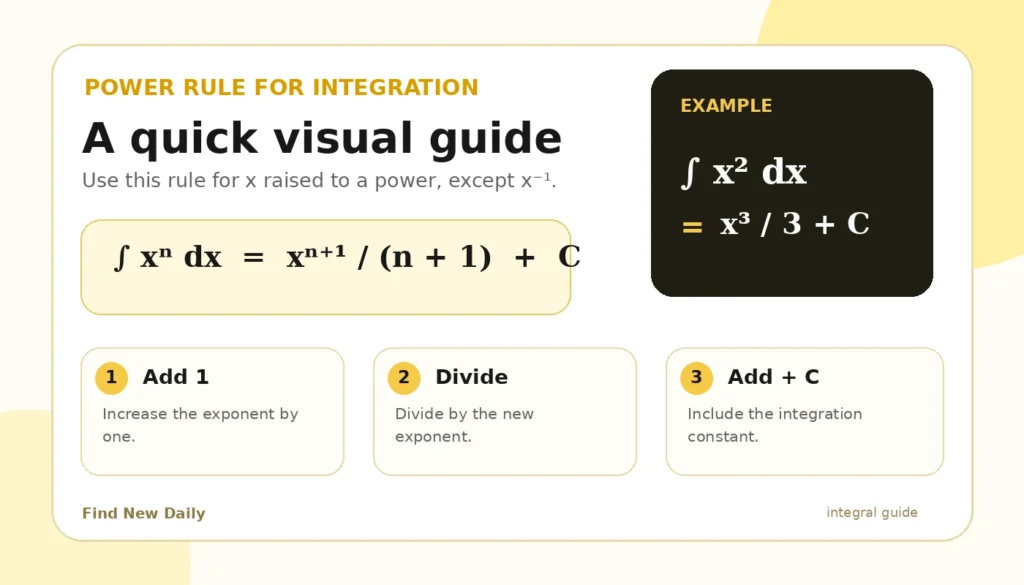
- ∫ x² dx = x³/3 + C — apply the power rule.
- ∫ sin(x) dx = -cos(x) + C — use the standard trigonometric rule.
- ∫₀³ x² dx = 9 — evaluate the antiderivative at both limits.
- ∫ 1/x dx = ln|x| + C — use the logarithmic integral rule.
About Integral Calculator with Steps | Definite & Indefinite Integral Solver
An integral describes accumulation. In a classroom exercise, that may mean finding an antiderivative. In a real problem, it may represent distance, total change, area, probability, cost, or another quantity built up over an interval.
Integration is often described as the reverse of differentiation, but it is more helpful to think of it as a way to combine many small changes into one meaningful total.
Definite vs. indefinite integrals
An indefinite integral gives a family of antiderivatives, so the answer includes + C. A definite integral uses lower and upper limits and produces a numerical value for the chosen interval.
Common integration rules
| Function | Integral |
|---|---|
| x^n | x^(n+1)/(n+1) + C, where n ≠ -1 |
| 1/x | ln|x| + C |
| sin(x) | -cos(x) + C |
| cos(x) | sin(x) + C |
| e^x | e^x + C |
| Constant k | kx + C |
Area under a curve
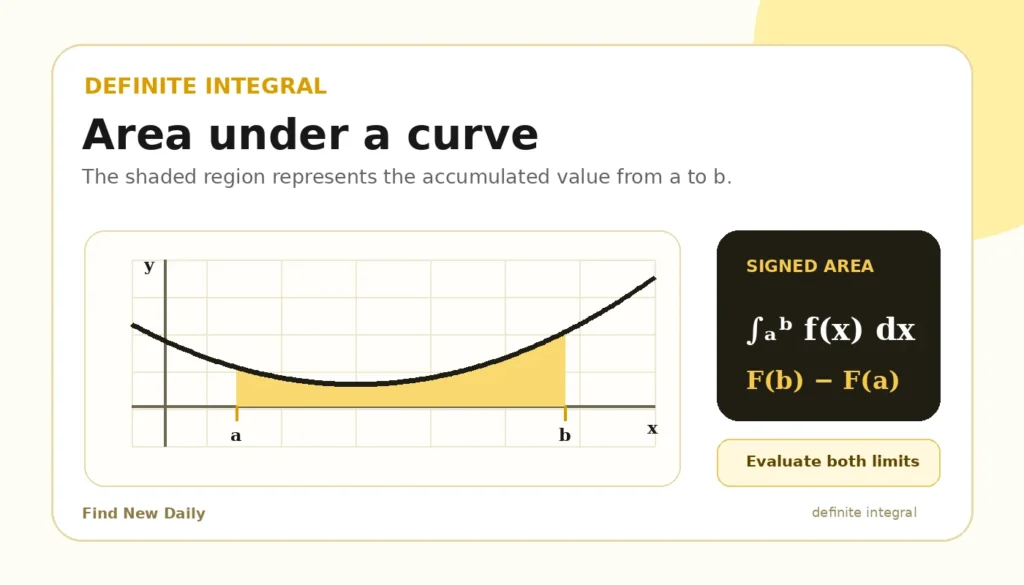
A definite integral can measure the signed area between a graph and the x-axis. Area above the axis contributes positively, while area below the axis contributes negatively.
For example, integrating velocity over time can give displacement. Similar ideas are used in engineering, economics, probability, and physics.
Who may find this useful?
- High-school and AP Calculus students
- College calculus learners
- Teachers and tutors preparing examples
- Engineering and physics students
- Anyone checking a common antiderivative
Calculator limitations
This tool focuses on common beginner and intermediate forms. Advanced substitutions, integration by parts, improper integrals, multivariable integrals, and specialist functions may require a more advanced symbolic mathematics system.
Integral Calculator with Steps | Definite & Indefinite Integral Solver FAQs
What is an integral calculator?
An integral calculator is an online calculus tool that helps solve integrals, find antiderivatives, and calculate definite integral values over an interval.
How do I use this integral calculator?
Select indefinite or definite integral, enter a function using x as the variable, add limits if needed, and click Calculate Integral to see the answer and steps.
What is an indefinite integral?
An indefinite integral gives the general antiderivative of a function and includes the constant of integration, written as + C.
What is a definite integral?
A definite integral calculates the accumulated value of a function between a lower and upper limit and returns a number.
What does + C mean in integration?
+ C represents the constant of integration because many functions can have the same derivative.
Can this calculator show steps?
Yes. It shows step-by-step explanations for the supported beginner and intermediate integral forms.
Can this calculator find area under a curve?
Yes. Choose a definite integral and enter lower and upper limits to calculate the signed value over the selected interval for supported functions.
What functions does this calculator support?
It supports x, powers of x, polynomial expressions, sin(x), cos(x), e^x, 1/x, and sqrt(x).
Why is my integral not supported?
This version focuses on common calculus forms. Advanced integrals may need substitution, integration by parts, trigonometric substitution, or another specialist method.
Is this calculator free?
Yes. It is free to use for learning, practice, and checking common calculus work.