Free step-by-step tool
Quadratic Formula Calculator With Steps
Enter a, b, and c below. Quadratic Formula Calculator With Steps will show the discriminant, the type of roots, and each calculation step without reloading the page.
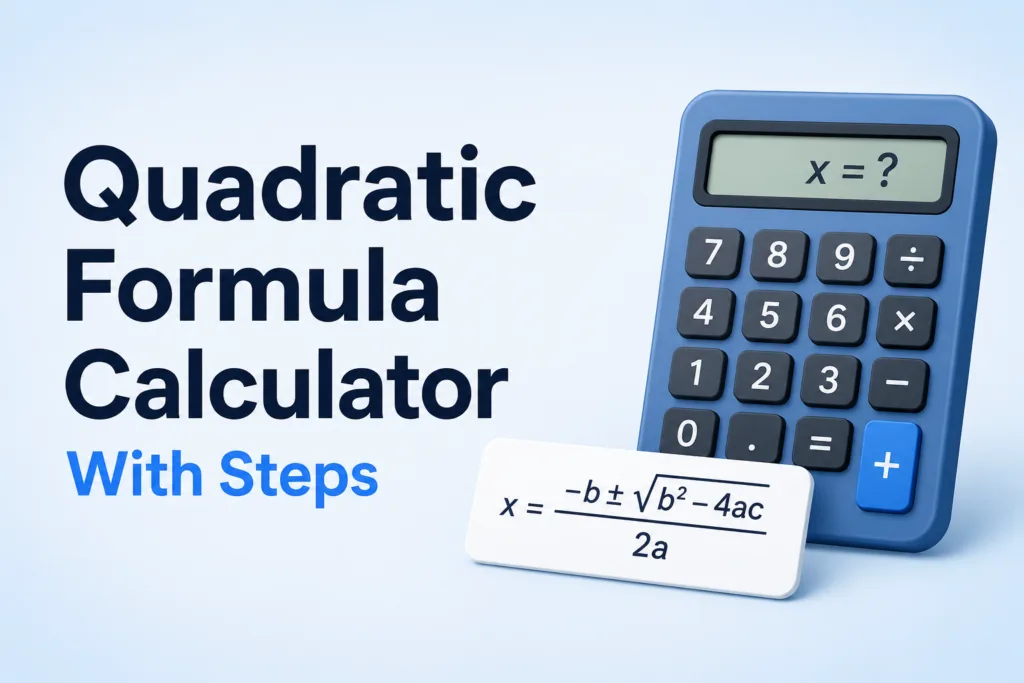
Enter the coefficients
Use the standard form ax² + bx + c = 0. The value of a cannot be zero.
Try a ready-made example
Your solution
Check the summary first, then follow the working below.
Step-by-step working
How to use Quadratic Formula Calculator With Steps
- Rewrite the equation as ax² + bx + c = 0.
- Enter the three coefficients with their correct signs.
- Select Calculate roots and review the discriminant.
- Use the copy button when you need the full working for your notes.
The calculator works with whole numbers, negative values, and decimals. Nothing is sent to a server; the answer is calculated in your browser.
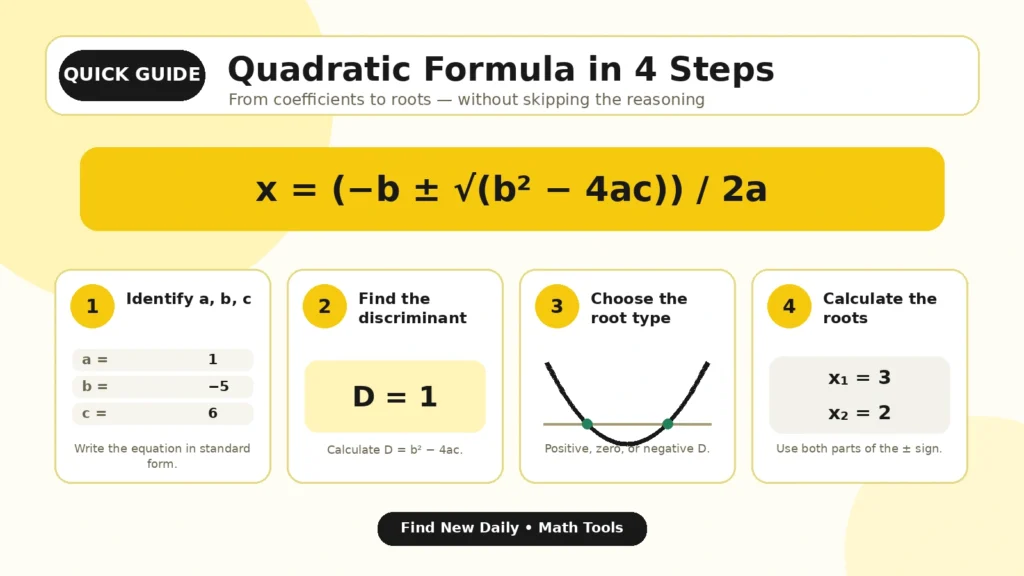
Read the complete quadratic formula guide
What the quadratic formula does
A quadratic equation contains an x² term and is normally written as ax² + bx + c = 0. The quadratic formula gives a dependable way to find the value of x even when the equation does not factor neatly.
x = (−b ± √(b² − 4ac)) / 2a
The ± sign is important. It tells you to calculate one answer with addition and another with subtraction. Sometimes those two calculations produce the same repeated root.
The discriminant explains the root type
Before finding the roots, look at b² − 4ac. This value is called the discriminant and it gives a useful preview of the answer.
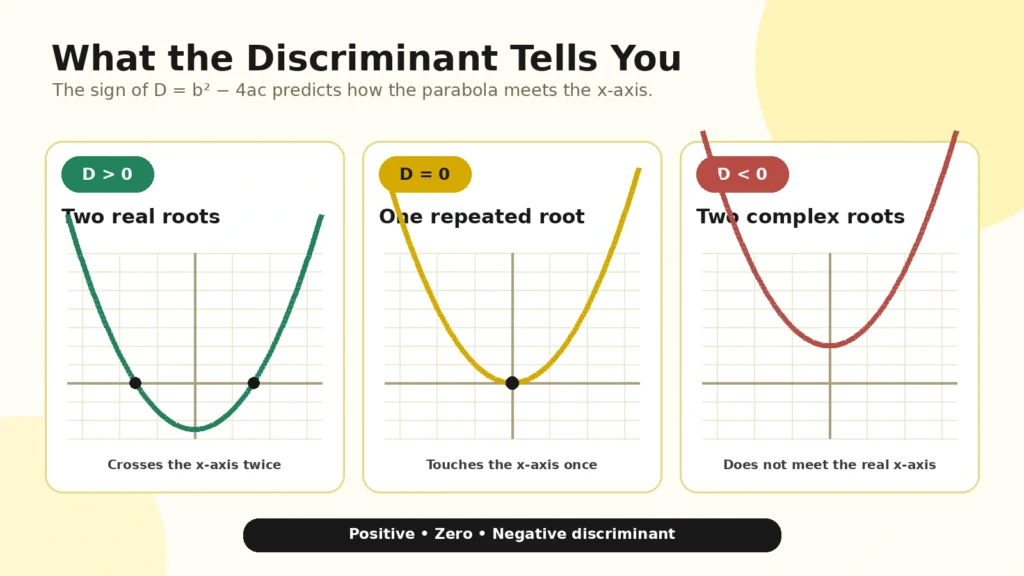
- D > 0: two different real roots.
- D = 0: one repeated real root.
- D < 0: two complex roots containing i.
On a graph, two real roots usually mean the parabola crosses the x-axis twice. A repeated root means it just touches the axis. Complex roots mean it does not meet the real x-axis.
Worked example: x² − 5x + 6 = 0
Here a = 1, b = −5, and c = 6. Start with the discriminant:
D = (−5)² − 4(1)(6) = 25 − 24 = 1
Because D is positive, there are two real roots. Substitute the values into the formula:
x = (5 ± √1) / 2
The two calculations give x = 3 and x = 2. You can load this exact example using the first example button above.
Small checks that prevent wrong answers
- Keep the sign attached to b. For example, b is −5 in x² − 5x + 6 = 0.
- Do not enter a as 0. That would make the equation linear rather than quadratic.
- Move every term to one side before identifying a, b, and c.
- Avoid rounding in the middle of the calculation. Round only the final decimal answer.
- Remember both parts of ± so you do not lose the second root.
This tool is useful for checking homework and practice, but the step list is included so you can still see how the answer was built.
Quadratic Formula Calculator With Steps FAQs
Can I enter decimal coefficients?
Yes. The calculator accepts whole numbers, negative numbers, and decimals for a, b, and c.
Why can a not be zero?
When a equals zero, the x² term disappears. The equation becomes linear, so the quadratic formula is no longer the correct method.
Does the calculator show complex roots?
Yes. A negative discriminant produces two complex roots, and the result is displayed using i.
What does a repeated root mean?
A repeated root occurs when the discriminant is zero. Both sides of the ± calculation lead to the same value of x.
Is this better than factoring?
Factoring can be quicker for simple equations, but the quadratic formula works consistently even when obvious factors are not available.
Can I use the result for SAT or ACT practice?
It can help you check practice problems involving quadratic roots and discriminants. Use the displayed steps to compare with your own working.