Free online calculator
Scientific Notation Calculator
Convert ordinary numbers, E notation, and powers of ten, or calculate with scientific notation. Results include standard form, engineering notation, and clear working steps.
Use this scientific notation calculator to convert a standard number, decimal, E notation value, or scientific notation expression into scientific notation, standard form, E notation, and engineering notation with clear steps.
Clickable examples
Step-by-step explanation
Recent conversions
Add, subtract, multiply, or divide numbers written in standard form, scientific notation, or E notation. The answer is shown in scientific notation, standard form, and E notation with a step-by-step solution.
Clickable examples
Step-by-step solution
Recent calculations
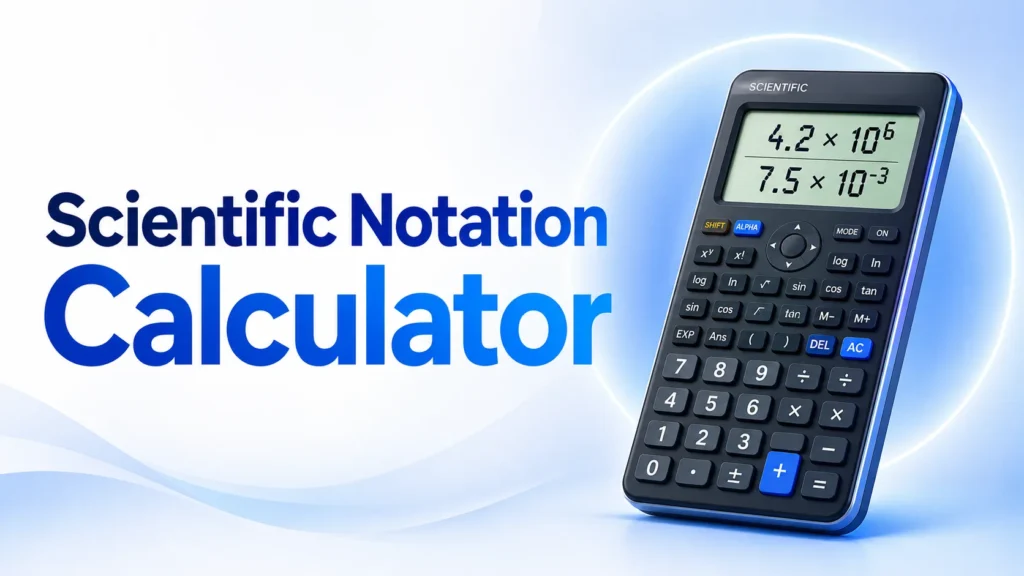
A practical guide to scientific notation calculator
About 6 minutesLong strings of zeros are easy to misread. This guide explains what the result means, why the decimal moves, and how to check your answer without turning the page into a textbook.
What scientific notation is really doing
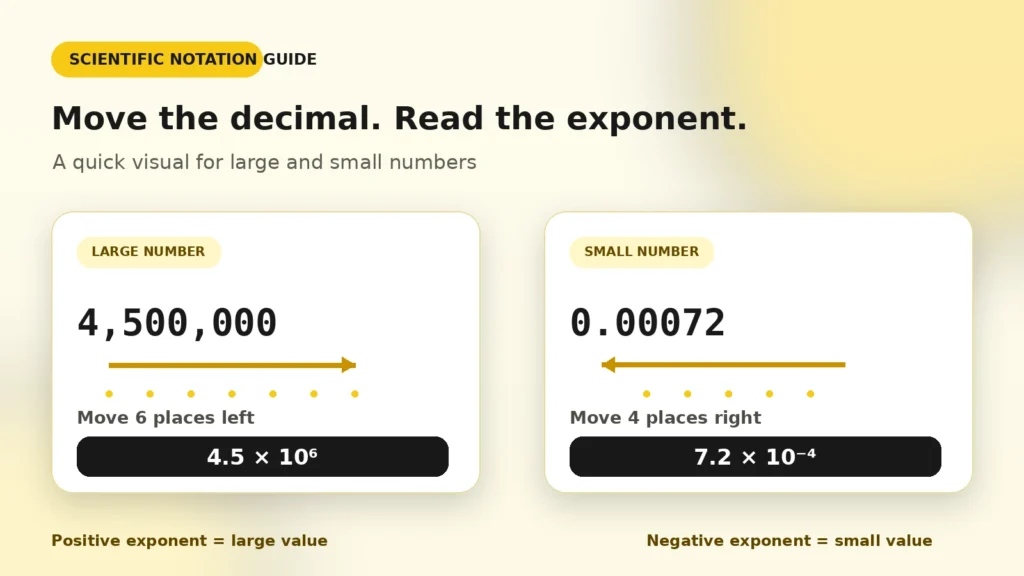
Scientific notation is a tidy way to write a number that is extremely large or extremely small. Instead of carrying every zero, the number is split into two parts: a short coefficient and a power of ten. For example, 4,500,000 becomes 4.5 × 10⁶. Nothing about the value changes; only the way it is written changes.
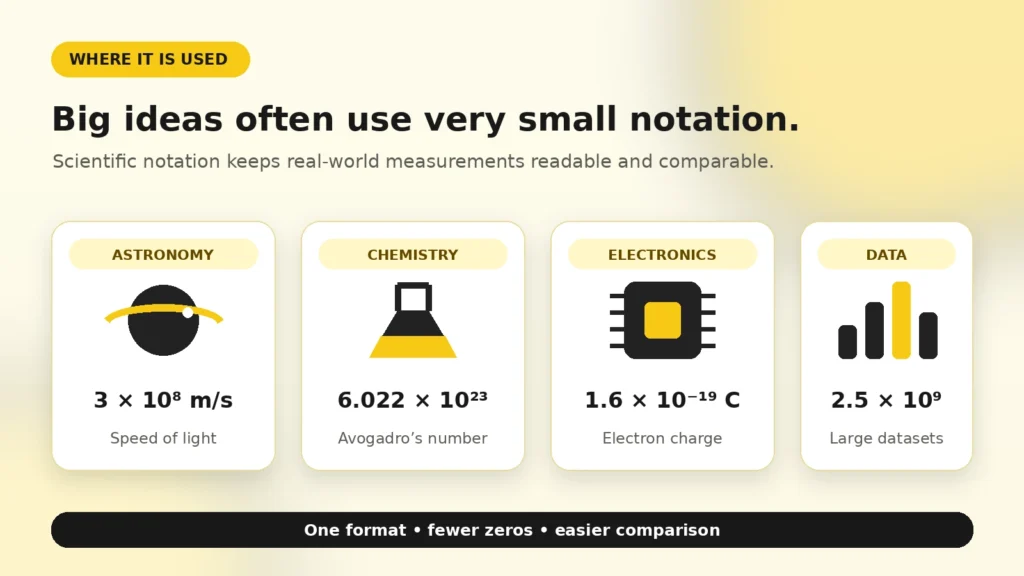
You will see this format in science classes, lab reports, engineering, astronomy, spreadsheets, and programming. It is also useful whenever counting decimal places by eye starts to feel unreliable.
How to use this calculator
- Enter a regular number, an E-notation value such as 3.72e8, or an expression such as 3.72 × 10^8.
- Leave conversion type on Auto Detect unless you need to force a specific direction.
- Choose significant figures or rounding only when your assignment, measurement, or report requires it.
- Select Calculate. The answer appears in scientific notation, standard form, E notation, engineering notation, and step-by-step form.
To add, subtract, multiply, or divide two values, switch to the second tab. Both input boxes accept ordinary numbers, scientific notation, and E notation.
Why the exponent can be positive or negative
Start by placing the decimal after the first non-zero digit. If you move the decimal to the left, the original number was large, so the exponent is positive. If you move it to the right, the original number was a small decimal, so the exponent is negative.
Worked conversion examples
| Original value | Scientific notation | What happened |
|---|---|---|
| 4,500,000 | 4.5 × 10⁶ | The decimal moved 6 places left. |
| 0.00072 | 7.2 × 10⁻⁴ | The decimal moved 4 places right. |
| 602,200,000,000,000,000,000,000 | 6.022 × 10²³ | A long value becomes easier to compare and copy. |
| 0.0000000016 | 1.6 × 10⁻⁹ | The negative exponent records nine decimal moves. |
Calculating with scientific notation
Addition and subtraction
The powers of ten need to match before coefficients can be added or subtracted directly. A reliable method is to convert both values to the same exponent, complete the operation, and then normalize the answer so the coefficient sits between 1 and 10.
Multiplication and division
For multiplication, multiply the coefficients and add the exponents. For division, divide the coefficients and subtract the exponents. The calculator also shows the ordinary-number version, which makes it easier to spot an unexpected result.
Scientific notation, E notation, and engineering notation
These formats describe the same value in different ways. 4.5 × 10⁶ is standard mathematical notation, while 4.5e6 is the compact version used by calculators, spreadsheets, and code. Engineering notation keeps exponents in multiples of three, which lines up neatly with metric prefixes such as kilo, mega, milli, micro, and nano.
Common mistakes worth checking
- The coefficient should normally be at least 1 and less than 10.
- A small decimal needs a negative exponent, not a positive one.
- Do not count the starting decimal position as one of the moves.
- Keep extra digits during the calculation and round only at the end.
- When adding or subtracting, match the exponents before combining coefficients.
Why this page keeps the calculator first
Most visitors arrive because they need an answer, not a long lesson. That is why the working calculator appears before the detailed guide. The extra explanation remains available for students, teachers, and anyone who wants to understand the method. On Find New Daily, the goal is to make the useful part quick without hiding the reasoning behind it.