Volume Calculator

Volume Calculator

Calculate volume for boxes, cubes, cylinders, cones, spheres, rooms, pools, concrete slabs, mulch, soil, gravel, and tanks.

Box / Rectangular Prism Volume

Cube Volume

Cylinder Volume

Cone Volume

Sphere Volume

Room Volume Calculator

Pool Volume Calculator

Concrete Volume Calculator

Mulch / Soil / Gravel Volume Calculator

Tank Volume Calculator

Your Volume Result

Formula Used

Step-by-Step Calculation

Volume Calculator

What Is a Volume Calculator?

A volume calculator is an online tool that helps you calculate the amount of space inside a three-dimensional object, container, room, tank, pool, box, cylinder, or construction area. Instead of calculating every formula manually, this volume conversion calculator lets you enter dimensions and instantly see results in cubic feet, cubic yards, cubic inches, gallons, liters, and cubic meters.

This tool is useful for homeowners, students, contractors, landscapers, pool owners, warehouse teams, DIY users, and anyone who needs a fast cubic feet calculator, gallons calculator, liters calculator, or cubic yards calculator.

How to Use This Volume Calculator

  1. Select the shape or real-life calculator type, such as box, cylinder, room, pool, concrete, mulch, soil, gravel, or tank.
  2. Enter the required dimensions, such as length, width, height, radius, diameter, depth, or thickness.
  3. Select your input unit from inches, feet, yards, centimeters, or meters.
  4. Click the Calculate Volume button.
  5. Review the results in cubic feet, cubic yards, gallons, liters, cubic inches, and cubic meters.

Common Volume Formulas

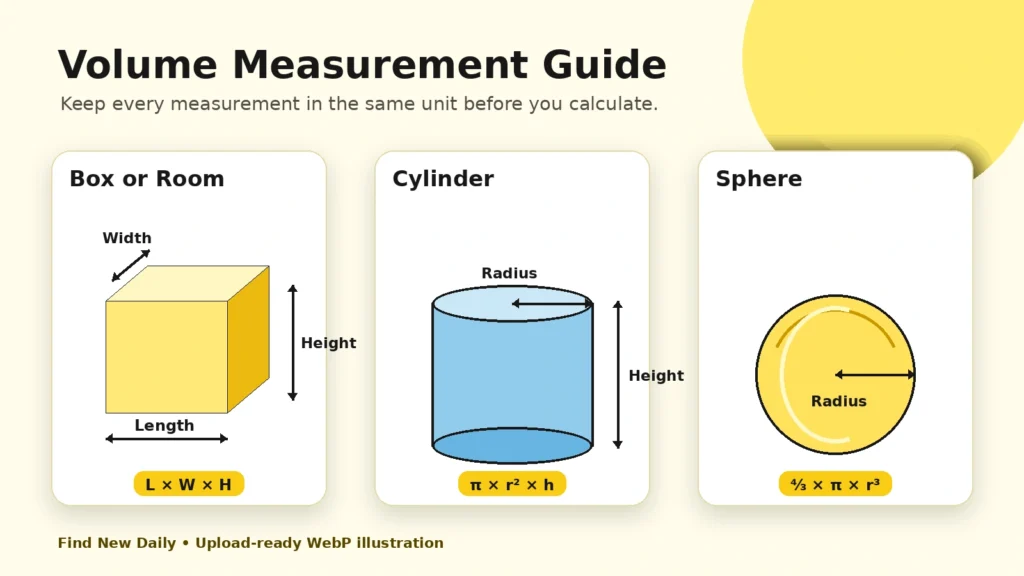
Rectangular Prism or Box Volume Formula

Volume = Length × Width × Height. This formula is used for a box volume calculator, package volume calculator, shipping box volume calculator, storage containers, rooms, rectangular tanks, and many rectangular objects.

Cube Volume Formula

Volume = Side × Side × Side, or Side³. Use this when all sides have the same length.

Cylinder Volume Formula

Volume = π × Radius² × Height. This cylinder volume calculator formula is useful for pipes, drums, round tanks, cans, and cylindrical containers.

Cone Volume Formula

Volume = 1/3 × π × Radius² × Height. This cone volume calculator formula is used when the object has a circular base and tapers to one point.

Sphere Volume Formula

Volume = 4/3 × π × Radius³. This sphere volume calculator formula is used for balls, round containers, and spherical objects.

Room Volume Formula

Room Volume = Room Length × Room Width × Ceiling Height. This is commonly shown in cubic feet for US users.

Pool Volume Formula

Rectangular Pool Volume = Length × Width × Average Depth. Round Pool Volume = π × Radius² × Average Depth. The calculator then converts cubic feet to gallons and liters.

Concrete Volume Formula

Concrete Volume = Length × Width × Thickness. In the United States, concrete is commonly ordered in cubic yards, so this concrete cubic yards calculator also converts cubic feet to cubic yards.

Mulch, Soil, and Gravel Volume Formula

Landscaping Volume = Area Length × Area Width × Depth. This is helpful for mulch calculator, soil volume calculator, gravel calculator, sand calculator, and landscaping material calculator searches.

Tank Volume Formula

Rectangular Tank Volume = Length × Width × Height. Cylindrical Tank Volume = π × Radius² × Height. Tank results can be shown in cubic feet, gallons, and liters.

Volume Calculator for Boxes and Packages

A box volume calculator helps you estimate the space inside shipping boxes, moving boxes, storage boxes, warehouse packages, and containers. Enter the length, width, and height to calculate cubic inches, cubic feet, cubic yards, gallons, liters, and cubic meters. This is useful when comparing package volume, planning shipping box volume, checking storage capacity, or estimating how much space a product will occupy.

Room Volume Calculator

A room volume calculator is useful for HVAC planning, air purifier sizing, ventilation estimates, heating and cooling calculations, and home improvement projects. Many US users search for a cubic feet room calculator or room cubic feet calculator because room volume is usually measured in cubic feet. To calculate HVAC room volume, multiply room length by room width by ceiling height.

Pool Volume Calculator in Gallons

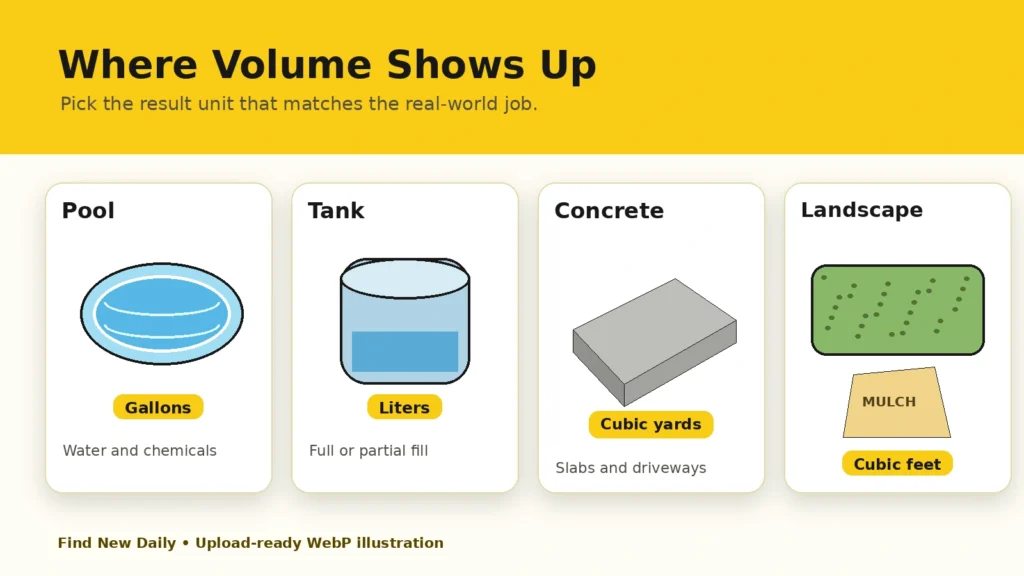
A pool volume calculator helps estimate how many gallons of water are in a swimming pool. This is important for pool chemical planning, water treatment, filtration, and maintenance. For a rectangular pool, multiply length by width by average depth. For a round pool, use π × radius² × average depth. This pool gallons calculator converts the result into gallons and liters so you can answer common questions like “how many gallons in my pool?”

Concrete Volume Calculator

A concrete volume calculator helps estimate concrete for slabs, driveways, patios, sidewalks, garage floors, footings, and small construction projects. Enter length, width, and thickness to calculate the base concrete volume. The tool also supports waste percentage because most concrete projects need a small extra amount for uneven ground, form variations, spillage, and finishing. In the US, concrete is usually ordered in cubic yards, so this concrete slab calculator and driveway concrete calculator shows cubic yards clearly.

Mulch, Soil, Gravel, and Landscaping Volume

Landscaping materials are often measured in cubic feet or cubic yards. This mulch volume calculator, soil volume calculator, gravel volume calculator, and landscaping material calculator helps estimate how much material you need for garden beds, pathways, yards, lawns, raised beds, and outdoor projects. Enter the area length, width, and depth, then add an extra percentage if you want a buffer for settling or uneven surfaces.

Tank Volume Calculator

A tank volume calculator is useful for water tanks, aquarium tanks, fuel tanks, storage tanks, and cylindrical containers. A water tank calculator or aquarium volume calculator often needs results in gallons and liters, not just cubic feet. This tool supports rectangular tanks and cylindrical tanks and includes a fill percentage option so you can calculate full or partially filled tank volume.

Volume Unit Conversions

Volume conversion is important because different projects use different units. Boxes may use cubic inches, rooms often use cubic feet, concrete is commonly ordered in cubic yards, pools and tanks are often measured in gallons, and scientific or international calculations may use liters or cubic meters.

Conversion Value Common Use
1 cubic foot 1728 cubic inches Boxes, packages, storage
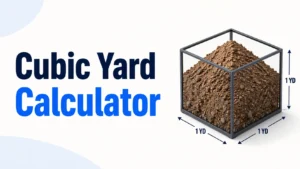
1 cubic yard 27 cubic feet Concrete, mulch, soil, gravel
1 cubic foot 7.48052 gallons Pools, tanks, containers
1 cubic foot 28.3168 liters Water, tanks, international use
1 gallon 231 cubic inches Liquid volume
1 cubic meter 1000 liters Metric volume

Why Volume Matters in Daily Life

Volume matters in everyday life because it helps you understand capacity, space, material quantity, and liquid amount. You may need a volume calculator when moving, shipping products, planning storage, ordering concrete, buying mulch or gravel, maintaining a swimming pool, sizing a water tank, setting up an aquarium, calculating HVAC room volume, or working on DIY home improvement projects.

Using a calculator reduces mistakes and helps you compare units such as cubic feet to gallons, cubic feet to cubic yards, cubic yards to cubic feet, cubic inches to gallons, and cubic meters to liters.

Frequently Asked Questions

What is a volume calculator?

A volume calculator is a tool that calculates the amount of three-dimensional space inside a shape, container, room, tank, pool, box, or material area.

How do I calculate volume?

To calculate volume, use the formula for the shape you are measuring. For example, a rectangular box uses length × width × height.

What is the formula for volume?

The formula depends on the shape. A box uses length × width × height, a cylinder uses π × radius² × height, and a sphere uses 4/3 × π × radius³.

How do I calculate the volume of a box?

Multiply the box length by the box width by the box height. The result is the box volume in cubic units.

How do I calculate cubic feet?

Use feet for all dimensions, then multiply length × width × height. The answer will be in cubic feet.

How many cubic feet are in a cubic yard?

There are 27 cubic feet in 1 cubic yard.

How many gallons are in a cubic foot?

There are approximately 7.48052 US gallons in 1 cubic foot.

How do I calculate pool volume in gallons?

Calculate the pool volume in cubic feet, then multiply by 7.48052 to convert cubic feet to gallons.

How do I calculate concrete volume?

Multiply length × width × thickness. Convert cubic feet to cubic yards by dividing by 27.

What unit is commonly used for concrete in the US?

Concrete is commonly ordered and sold in cubic yards in the United States.

Can this calculator convert cubic feet to gallons?

Yes. The calculator converts cubic feet to gallons using 1 cubic foot = 7.48052 gallons.

Can I use this calculator for mulch, soil, gravel, and sand?

Yes. Choose the mulch, soil, or gravel option and enter the area length, width, and depth.

Can I use this calculator for room volume?

Yes. Select the room calculator and enter room length, room width, and ceiling height.

Can I use this calculator for tank volume?

Yes. The calculator supports rectangular and cylindrical tanks and can show results in cubic feet, gallons, and liters.

Is this volume calculator accurate?

The calculator uses standard geometry formulas and common US-friendly conversions. Accuracy depends on the measurements you enter.