Free calculator with steps
Pythagorean Theorem Calculator – Find Missing Side with Steps
Enter any two values and leave the unknown side blank. The calculator will find the hypotenuse or a missing leg without changing the working method you already use.
Result
Step-by-step solution
Free right triangle solver
Pythagorean Theorem Calculator – Find Missing Side with Steps
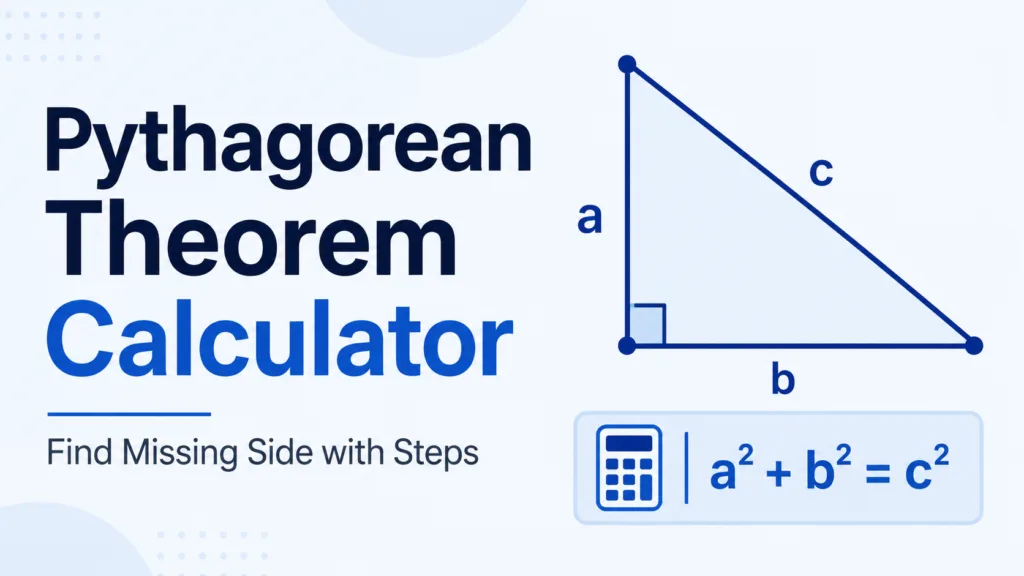
Use this free Pythagorean theorem calculator to find the missing side of a right triangle. Enter any two side lengths, and the calculator will solve the third side with step-by-step work.
This calculator can find the hypotenuse, calculate a missing leg, and show the full Pythagorean theorem formula.
How to Use Pythagorean Theorem Calculator – Find Missing Side with Steps
- Enter any two known sides of a right triangle.
- Leave the missing side blank.
- Choose your unit, such as inches, feet, or meters.
- Choose how many decimal places you want.
- Click the calculate button.
- Review the answer and step-by-step solution.
Practical measurement
See the Right Triangle in Everyday Jobs
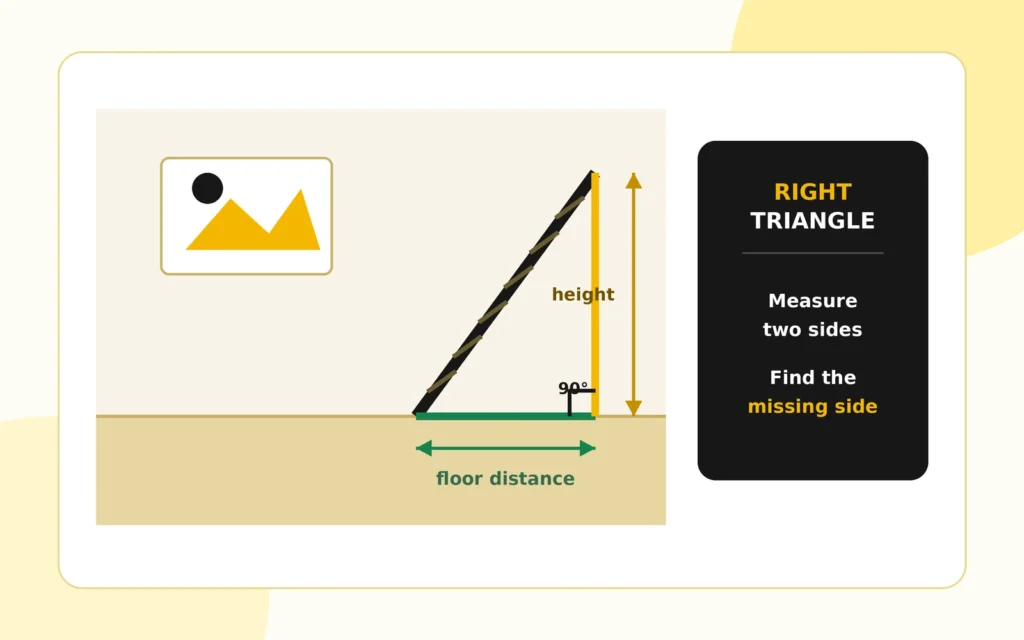
A diagonal across a room, a ladder leaning against a wall, and a roof slope can all create a right triangle. Measure two sides in the same unit, enter them above, and let the calculator handle the square root.
The result is most useful when your starting measurements are accurate, so double-check the tape measure before using the answer for a real project.
Pythagorean Theorem Formula
The Pythagorean theorem is used for right triangles. It says that the square of the hypotenuse is equal to the sum of the squares of the other two sides.
- a and b are the legs of the triangle.
- c is the hypotenuse.
- The hypotenuse is always the longest side and is opposite the 90-degree angle.
The calculator and essential formula are above. Open the complete guide for worked examples, common triples, real-life uses, and frequently asked questions.
How to Find the Hypotenuse
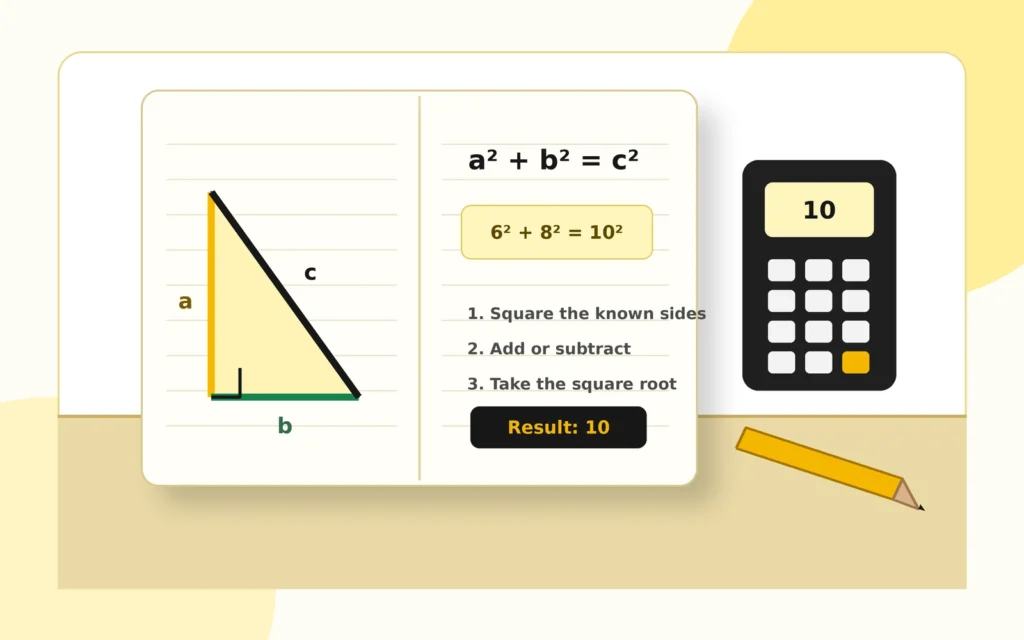
To find the hypotenuse, square both legs, add the results, and take the square root. This is useful when you know both legs of a right triangle and need the longest side.
Example
If a = 3 and b = 4:
c² = 3² + 4²
c² = 9 + 16
c² = 25
c = 5
How to Find a Missing Leg
If you know the hypotenuse and one leg, subtract the square of the known leg from the square of the hypotenuse, then take the square root.
Example
If c = 13 and a = 5:
b² = 13² - 5²
b² = 169 - 25
b² = 144
b = 12
Understand the steps
Square, Add or Subtract, Then Take the Root
When the hypotenuse is missing, add the two squared legs. When a leg is missing, subtract the known leg’s square from the hypotenuse’s square. The final square root gives the missing length.
The result panel keeps the formula and substituted values together, which makes it easier to check homework or explain the method.
Common Pythagorean Triples
Pythagorean triples are whole number side lengths that form perfect right triangles. The 3-4-5 triangle is especially common in construction because it helps check whether a corner is square.
| Leg a | Leg b | Hypotenuse c |
|---|---|---|
| 3 | 4 | 5 |
| 5 | 12 | 13 |
| 6 | 8 | 10 |
| 7 | 24 | 25 |
| 8 | 15 | 17 |
| 9 | 12 | 15 |
| 9 | 40 | 41 |
| 10 | 24 | 26 |
| 12 | 16 | 20 |
| 20 | 21 | 29 |
Real-Life Uses of the Pythagorean Theorem
This right triangle side calculator is helpful for students, parents, teachers, construction workers, DIY users, roofers, carpenters, homeowners, and anyone who needs to find the missing side of a right triangle.
- Finding the diagonal distance across a room
- Measuring TV screen size
- Checking if a corner is square
- Calculating ladder length
- Construction layout
- Woodworking projects
- Roofing measurements
- Fence and deck planning
- School math homework
- Finding the shortest straight-line distance between two points
Pythagorean Theorem Examples
Example 1: Find the hypotenuse
If a = 6 and b = 8, then c² = 6² + 8². The answer is c = 10.
Example 2: Find a missing leg
If c = 13 and a = 5, then b² = 13² - 5². The answer is b = 12.
Example 3: Construction example
A rectangular room is 12 feet wide and 16 feet long. The diagonal distance is 20 feet.
Example 4: 3-4-5 triangle check
A 3-4-5 triangle can help builders and DIY users check whether a corner is a true 90-degree angle.
Why Use This Right Triangle Calculator?
This Pythagorean theorem solver is designed to make right triangle calculations easier and faster. Instead of manually calculating square roots, you can enter two sides and instantly get the missing side with clear work.
- Fast calculation
- Step-by-step solution
- Helps with homework
- Useful for construction and DIY
- Works with inches, feet, meters, and other units
- Mobile-friendly
- No manual square root calculation needed
Frequently Asked Questions
What is the Pythagorean theorem?
The Pythagorean theorem is a formula used to find the missing side of a right triangle. The formula is a² + b² = c².
What is the hypotenuse?
The hypotenuse is the longest side of a right triangle. It is always opposite the 90-degree angle.
How do I calculate the hypotenuse?
Square both legs, add them together, and then take the square root of the result.
Can this calculator find a missing leg?
Yes. If you enter the hypotenuse and one leg, the calculator can find the other missing leg.
Can I use feet and inches?
Yes. You can select feet, inches, yards, meters, centimeters, and other units from the unit dropdown.
Why does the calculator say the hypotenuse must be the longest side?
In a right triangle, the hypotenuse is always the longest side. If the hypotenuse is shorter than a leg, the triangle is not valid.
What is a 3-4-5 triangle?
A 3-4-5 triangle is a common right triangle where the side lengths are 3, 4, and 5. It is often used in construction to check square corners.
Is this calculator useful for school homework?
Yes. The calculator shows the answer and step-by-step work, which can help students understand the formula.