Options Profit Calculator
Use this options profit calculator to estimate potential profit, loss, breakeven price, maximum risk, total premium, return percentage, and a payoff chart for common US stock options trades.
Options Profit Summary
Review the estimated net profit or loss, breakeven price, maximum profit, maximum loss, premium, return, and option status.
Options Payoff Chart
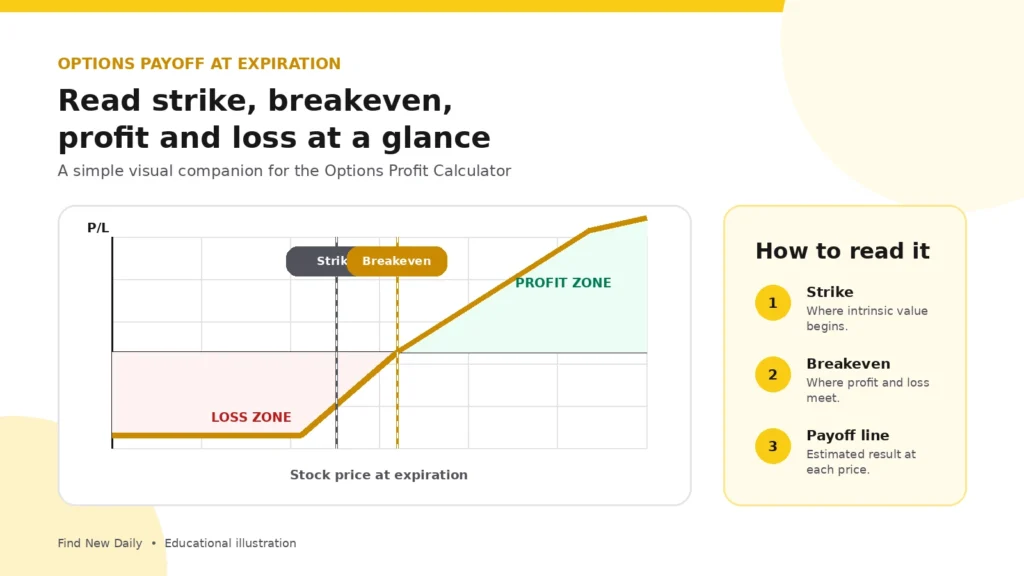
The payoff chart shows estimated profit and loss across a range of possible stock prices at expiration.
Profit/Loss Table at Different Stock Prices
Compare the estimated option value, net profit/loss, and return percentage at common price changes.
| Stock price at expiration | Option value | Net profit/loss | Return percentage |
|---|
Plain-English Explanation
What Is an Options Profit Calculator?
An options profit calculator is a trading calculator that helps estimate potential profit, potential loss, breakeven price, maximum risk, and possible reward before entering an options trade. This options calculator is designed for simple single-leg trades such as long calls, long puts, short calls, and short puts.
Traders use an option profit calculator to compare different stock prices at expiration and understand how the trade may perform. Instead of manually calculating every scenario, this options payoff calculator creates result cards, a payoff chart, and a profit/loss table so you can review the numbers quickly.
How This Options Profit Calculator Works
This stock options calculator uses your selected option type, current stock price, strike price, premium, number of contracts, contract size, expected price at expiration, and optional trading fees. After you click calculate, the tool estimates net profit or loss, breakeven, maximum profit, maximum loss, total premium, return percentage, option status, and shares controlled.
- Option type: Choose long call, long put, short call, or short put.
- Strike price: The agreed exercise price of the option contract.
- Premium: The price paid or received per share for the option.
- Contracts: The number of option contracts in the trade.
- Contract size: The number of shares controlled by each contract, usually 100 for standard US equity options.
- Stock price at expiration: Your expected price of the underlying stock when the option expires.
- Fees: Optional commissions or other trading costs.
Call Option Profit Formula
A call option generally increases in value when the underlying stock price rises above the strike price. A call option profit calculator helps estimate whether the expected stock move is large enough to cover the premium and fees.
For a long call, the buyer pays a premium and benefits if the stock rises enough. For a short call, the seller receives a premium but may face unlimited theoretical risk if the stock rises sharply.
Put Option Profit Formula
A put option generally increases in value when the underlying stock price falls below the strike price. A put option profit calculator helps traders estimate downside scenarios and breakeven levels.
For a long put, the buyer usually benefits when the stock price declines. For a short put, the seller receives premium but may lose money if the stock falls below the breakeven price.
What Is Breakeven in Options Trading?
Breakeven is the stock price at expiration where the trade is neither profitable nor unprofitable before considering taxes and any unlisted costs. This options breakeven calculator uses these basic breakeven formulas:
- Long call breakeven: Strike price + premium paid.
- Long put breakeven: Strike price - premium paid.
- Short call breakeven: Strike price + premium received.
- Short put breakeven: Strike price - premium received.
What Is Maximum Profit?
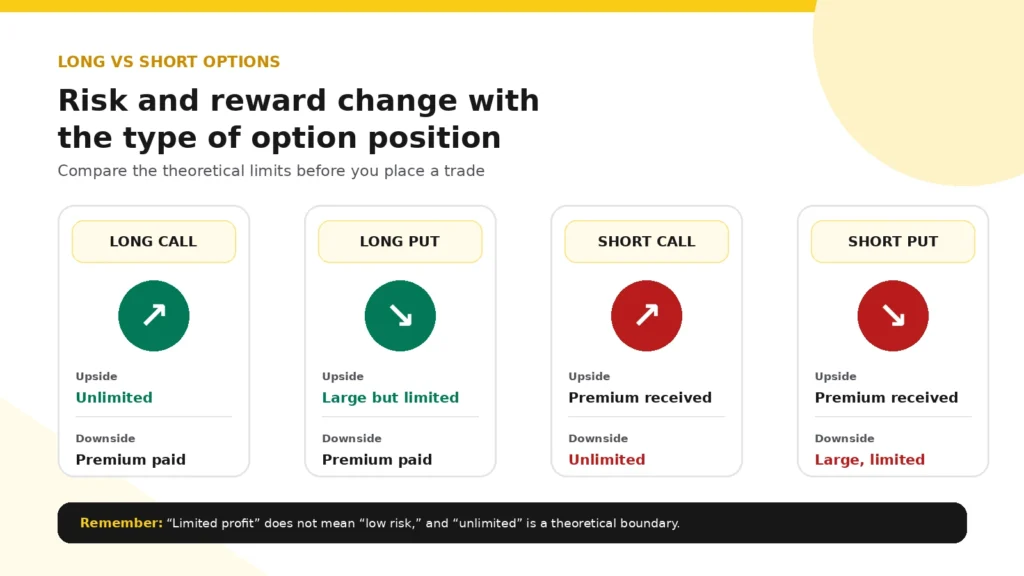
Maximum profit depends on the option position. Long calls have unlimited theoretical upside because a stock can keep rising. Long puts have large but limited potential profit because a stock cannot fall below zero. Short calls have limited maximum profit equal to the premium received, but they carry unlimited theoretical risk. Short puts have limited maximum profit equal to the premium received.
This options max profit calculator displays “Unlimited” where the theoretical maximum profit cannot be capped by the formula.
What Is Maximum Loss?
Maximum loss is the most the trade can theoretically lose based on the selected option position. Long option buyers usually risk the premium paid plus fees. Short option sellers may have much larger risk. A short call can have unlimited theoretical loss if the stock price rises significantly. A short put can lose a large amount if the stock falls sharply.
This options max loss calculator is helpful for understanding risk before entering a trade, but it does not replace professional risk management or financial advice.
Options Contract Size
One standard US equity options contract usually controls 100 shares of the underlying stock. For example, buying 1 call option with a $3.00 premium usually costs $300 before fees because $3.00 × 100 shares = $300. This options trading calculator lets you change the contract size because some contracts may be adjusted or structured differently.
Long Call Example
Suppose a stock is trading at $100. You buy one long call with a $105 strike price and pay a $3 premium. The contract size is 100 shares. Your total premium paid is $300 before fees. The breakeven price is $108 because $105 strike + $3 premium = $108.
If the stock expires at $115, the intrinsic value is $10 per share. The profit per share is $10 - $3 = $7. For one 100-share contract, the estimated profit is $700 before fees.
Long Put Example
Suppose a stock is trading at $100. You buy one long put with a $95 strike price and pay a $2.50 premium. The contract size is 100 shares. Your total premium paid is $250 before fees. The breakeven price is $92.50 because $95 strike - $2.50 premium = $92.50.
If the stock expires at $85, the put has $10 of intrinsic value. The profit per share is $10 - $2.50 = $7.50. For one contract, the estimated profit is $750 before fees.
Short Call Example
Suppose you sell one short call with a $110 strike price and receive a $2 premium. The total premium received is $200 before fees. The breakeven price is $112 because $110 strike + $2 premium = $112.
Short Put Example
Suppose you sell one short put with a $90 strike price and receive a $2 premium. The total premium received is $200 before fees. The breakeven price is $88 because $90 strike - $2 premium = $88.
If the stock expires above the strike price, the put may expire worthless and the seller may keep the premium. If the stock falls below breakeven, the short put begins losing money.
Why Traders Use an Options Payoff Chart
An options payoff chart gives a visual view of where an option trade may make money or lose money. The zero line shows where profit turns into loss. The breakeven marker shows the price needed for the trade to become profitable. The strike price marker helps show when the option has intrinsic value.
This options profit loss calculator includes a responsive payoff chart so traders can quickly understand potential outcomes across a range of stock prices.
Options Trading Risk Disclaimer
Options Profit Calculator FAQs
What is an options profit calculator?
An options profit calculator estimates potential profit, loss, breakeven price, maximum profit, maximum loss, premium, and return percentage for an options trade.
How do I calculate profit on a call option?
For a long call, subtract the premium paid from the intrinsic value. Intrinsic value is the stock price at expiration minus the strike price, but not less than zero.
How do I calculate profit on a put option?
For a long put, subtract the premium paid from the intrinsic value. Intrinsic value is the strike price minus the stock price at expiration, but not less than zero.
What is the breakeven price for a call option?
For a long call, breakeven is the strike price plus the premium paid. For a short call, breakeven is also commonly calculated as strike price plus premium received.
What is the breakeven price for a put option?
For a long put, breakeven is the strike price minus the premium paid. For a short put, breakeven is commonly calculated as strike price minus premium received.
Can I lose more than the premium paid?
Long option buyers usually risk the premium paid plus fees. Short option sellers can lose more than the premium received, and short calls have unlimited theoretical risk.
How many shares does one options contract control?
One standard US equity options contract usually controls 100 shares, although adjusted contracts may have a different size.
What is maximum profit in options trading?
Maximum profit is the largest theoretical gain for a position. It depends on whether the trade is a long call, long put, short call, or short put.
What is maximum loss in options trading?
Maximum loss is the largest theoretical loss for a position. Long options usually have limited loss, while short options may have larger or unlimited theoretical risk.
Does this calculator include commissions and fees?
Yes. You can enter optional commissions or fees, and the calculator subtracts those fees from estimated profit or adds them to estimated loss where applicable.
Is this options calculator for US stock options?
Yes. The calculator is designed around standard US equity options, where one standard contract usually controls 100 shares.
Is this calculator financial advice?
No. This calculator is for educational and informational purposes only and does not provide financial, investment, tax, or trading advice.